
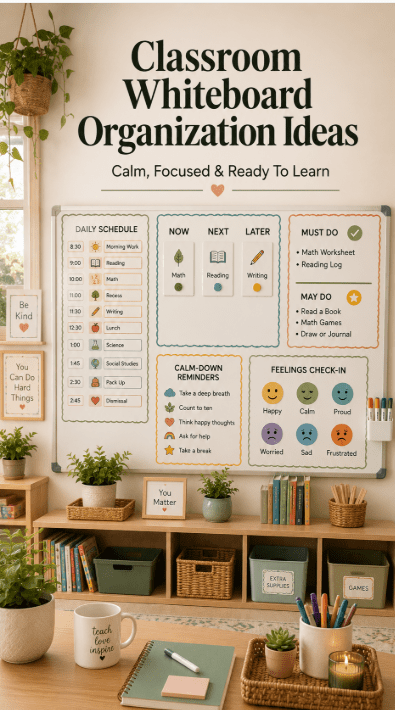
A classroom whiteboard can be so much more than a place to write the date, homework, or quick notes before the bell rings.
When it is organized with intention, it becomes a visual anchor for the whole classroom. It tells students what is happening, what matters today, what they can do next, and where they can look when they feel unsure. For children who struggle with transitions, attention, anxiety, impulsivity, or simply the busy rhythm of a school day, a well-planned whiteboard can quietly support emotional regulation and independence.
The best classroom whiteboard organization ideas are not just pretty. They are predictable, easy to understand, and simple enough to maintain on a real school day.
In this guide, you will find practical classroom whiteboard organization ideas that help students feel calmer, more focused, and more confident. You will also learn how to create each section step by step, why it works from a psychological standpoint, and how to avoid turning your board into visual clutter.
This post may contain affiliate links, including Amazon and selected partner links. If you make a purchase through these links, I may earn a small commission at no extra cost to you.
Why Classroom Whiteboard Organization Matters for Emotional Regulation
Children do not only learn through spoken instructions. They also learn through rhythm, repetition, environment, and visual cues.
A disorganized whiteboard can unintentionally add to the noise of the classroom. When the board is filled with old notes, random reminders, crowded writing, and too many colors, students may not know where to look. For some children, that creates mental clutter. For others, it becomes one more reason to ask repeated questions, miss instructions, or feel overwhelmed.
A well-organized whiteboard does the opposite. It creates a sense of structure.
From a psychological standpoint, organized visual information can support:
Predictability. Children feel safer when they know what is coming next. A clear daily schedule or routine board reduces uncertainty and can make transitions feel less abrupt.
Executive functioning. Many students are still developing planning, working memory, task initiation, and self-monitoring skills. A whiteboard can act like an external memory system, helping them see what to do instead of holding every instruction in their mind.
Emotional regulation. When students are dysregulated, verbal directions may be harder to process. Simple visual cues, such as “pause,” “breathe,” “ask for help,” or “next step,” can support regulation without requiring a long conversation.
Independence. A predictable board helps students answer some of their own questions. Instead of asking “What are we doing now?” or “What do I do when I’m finished?” they can learn to check the board first.
Belonging. When a whiteboard includes student jobs, class goals, kindness reminders, or shared celebrations, it communicates: this is our space, and you are part of it.
If you work with children who need additional support with regulation, sensory needs, or emotional safety, you may also like this related guide: Sensory Room Design for Counselors: How to Create Calming Spaces that Support Regulation and Healing.
Start With a Simple Whiteboard Layout Before You Add Anything Else
Before you buy new supplies or create beautiful labels, take a few minutes to plan the board like a map.
A helpful classroom whiteboard usually needs zones. Each zone should have a clear purpose. If every section is competing for attention, students will stop using the board as a guide.
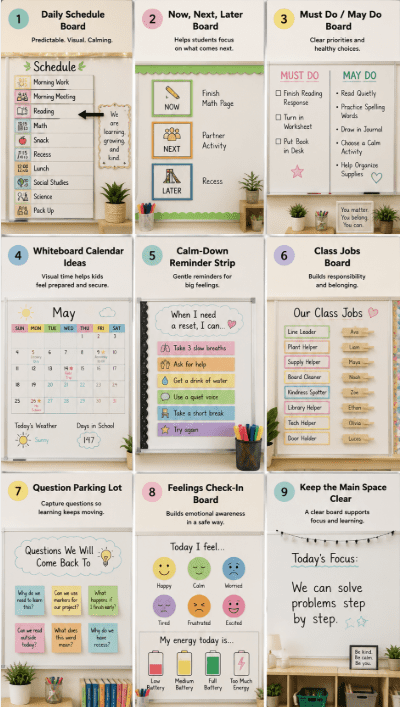
A simple classroom whiteboard organization layout could include:
One section for the daily schedule
One section for “must do” tasks
One section for “may do” choices
One section for reminders or announcements
One small section for calm-down or coping reminders
One section for student jobs or class responsibility
You do not need all of these sections at once. In fact, starting small is usually better.
How to create the layout
First, stand at the back of the classroom and look at your whiteboard from a student’s perspective. Ask yourself: What needs to be visible from across the room? What can be smaller? What should students see first?
Then divide the board into zones using thin magnetic borders, washi tape, painter’s tape, or simple dry erase lines. Keep the largest section for whole-class instruction. Place routine information along the side or top where it stays consistent.
A practical layout might look like this:
Left side: daily schedule
Top right: date and class goal
Middle: lesson space
Bottom right: must do/may do
Small corner: calm-down reminder or coping skill
The key is to make the board predictable. If the schedule is always on the left, students learn where to look. If the “may do” options are always in the same corner, they do not need a new explanation every day.
From a mental health perspective, consistency reduces unnecessary decision-making. Students can save more of their energy for learning, social problem-solving, and emotional regulation.
Create a Daily Schedule Section That Reduces Transition Stress
One of the most valuable classroom whiteboard organization ideas is a clear daily schedule.
Transitions are often difficult for children because they require stopping one activity, shifting attention, managing emotions, moving materials, and beginning something new. For students with anxiety, ADHD, autism, sensory sensitivities, or executive functioning challenges, transitions may feel especially hard.
A daily schedule gives students a visual pathway through the day.
How to create a daily schedule board
Choose one vertical section of your whiteboard, ideally on the left side. Write or attach the day’s activities in order from top to bottom.
For younger students, use simple words with icons when possible:
Morning work
Circle time
Reading
Snack
Math
Recess
Art
Lunch
Quiet reading
Pack up
Use magnetic labels if your schedule changes often. You can also write each subject or activity on a small laminated card with a magnetic strip on the back.
Add a small arrow, magnet, or clip that moves down the schedule as the day progresses. This “where we are now” marker is especially helpful for children who repeatedly ask what comes next.
For older students, the schedule can be simpler:
Warm-up
Mini lesson
Group work
Independent practice
Reflection
Homework reminder
Helpful tips
Keep the schedule short enough to read quickly. Too many details can make it overwhelming.
Use calm, consistent colors. For example, blue for academic lessons, green for breaks, and orange for transitions.
Review the schedule briefly in the morning. Then refer back to it before transitions.
When something changes, update the board and say it clearly: “Our library time moved after lunch today. I changed it on the schedule so we can all see the new plan.”
This teaches flexibility in a supported way. Children learn that plans can change, but they are not left confused.
Add a “Now, Next, Later” Area for Students Who Need Extra Support
A full daily schedule is helpful, but some students need a more immediate visual cue.
A “Now, Next, Later” board is one of the simplest ways to support children who become overwhelmed by too many steps. It narrows the focus to what is happening right now, what comes next, and what will happen after that.
This can be especially useful during busy mornings, small-group work, therapy sessions, school counseling lessons, or high-energy parts of the day.
How to create it
Choose a small corner of the whiteboard and write:
Now
Next
Later
Under each word, place one task or activity.
For example:
Now: finish math page
Next: partner game
Later: recess
Or:
Now: read quietly
Next: SEL lesson
Later: lunch
Use magnetic picture cards for younger students or simple written phrases for older children.
Why it works psychologically
The “Now, Next, Later” format supports attention and emotional regulation because it reduces the mental load. Instead of asking a child to process the entire day, it gives them a manageable sequence.
It also helps children tolerate non-preferred tasks. When they can see that something preferred is coming later, they may feel more capable of staying with the current task.
For example, “Now we write two sentences, next we share with a partner, later we choose a quiet activity” feels more manageable than “finish your work.”
Use a “Must Do / May Do” Board to Reduce Repeated Questions
Every classroom has moments when students finish at different times. Without a clear system, this can quickly turn into repeated questions:
“What do I do now?”
“Can I draw?”
“Can I read?”
“Can I use the computer?”
“I’m done. Now what?”
A “Must Do / May Do” section helps students understand priorities and choices.
How to create it
Divide a small section of the whiteboard into two columns:
Must Do
May Do
Under “Must Do,” write the required tasks students need to complete first.
Under “May Do,” write approved choices for early finishers.
Example:
Must Do:
Finish reading response
Turn in worksheet
Put book in desk
May Do:
Read quietly
Practice spelling words
Draw in journal
Choose a calm activity
Help organize supplies
You can make this section magnetic so it is easy to update each day.
Why it helps students
This board supports task completion, independence, and self-monitoring. It also reduces the emotional stress that can happen when expectations feel unclear.
For students who struggle with impulsivity, the “May Do” choices provide boundaries without constant correction. Instead of saying “No, not that” repeatedly, you can calmly point to the board and say, “Check the May Do list.”
For students who are anxious about doing the wrong thing, the board offers reassurance. They can see what is allowed and what comes next.
Add Whiteboard Calendar Ideas for Predictable Classroom Routines
Whiteboard calendar ideas are especially helpful for classrooms where students need support with time, sequence, and upcoming events.
A classroom calendar does not need to be complicated. It should help students understand the rhythm of the week or month.
How to create a simple whiteboard calendar
Use magnetic calendar tape, dry erase grid lines, or a pre-made magnetic calendar template.
Include:
Month
Date
Day of the week
Special events
Important deadlines
Birthdays or celebrations
Upcoming schedule changes
For younger students, add weather, season, or “days in school” if that fits your routine.
For older students, use the calendar for projects, tests, assemblies, field trips, and class goals.
Add an emotional regulation layer
You can also use the calendar to support emotional preparation.
For example, if there will be a fire drill, assembly, substitute teacher, field trip, or testing day, mark it on the calendar ahead of time. Many children cope better when they are not surprised by big changes.
A small “change coming” symbol can be useful. It could be a star, a gentle exclamation mark, or a small colored magnet. The goal is not to create worry. The goal is to help students prepare.
You might say, “Tomorrow will look a little different because we have an assembly. I put it on the calendar so we can remember and talk about what to expect.”
This type of preparation is especially supportive for children who experience school anxiety or struggle with transitions.
Create a Calm-Down Reminder Strip on the Whiteboard
A classroom whiteboard can also include a small emotional regulation support area.
This does not need to be large or overly therapeutic. A simple calm-down reminder strip can help students remember coping tools when emotions run high.
How to create it
Choose a calm corner of the whiteboard, preferably away from the busiest teaching space.
Write a title such as:
When I need a reset, I can…
Then list three to five simple strategies:
Take 3 slow breaths
Ask for help
Get a drink of water
Use a quiet voice
Take a short movement break
Put my hand on my heart
Name the feeling
Try again
You can also use small icons: a breath cloud, water drop, hand, heart, or walking feet.
Why this matters
When children are upset, embarrassed, angry, or overwhelmed, they often cannot easily access verbal problem-solving. A visual cue can act as a gentle reminder.
The goal is not to force calm or make children hide their emotions. The goal is to give them a bridge back to regulation.
This section can also normalize coping skills for the whole class. Instead of calm-down strategies being something only “certain kids” need, they become part of the classroom culture.
For more ideas related to emotional expression, you can connect this article with: Creative Craft Ideas to Help Children Express Anger.
Use the Whiteboard for Class Jobs and Student Responsibility
A well-organized whiteboard can also build belonging.
Children often feel more invested in a classroom when they have meaningful roles. A class jobs section helps students see that they are part of a shared community.
How to create it
Make a small section titled:
Class Helpers
Our Jobs
Ways We Care for Our Room
Then list a few simple roles:
Line leader
Plant helper
Supply helper
Board cleaner
Kindness spotter
Library helper
Tech helper
Door holder
Use name magnets or clothespins with student names so jobs can rotate easily.
Psychological value
Class jobs support responsibility, cooperation, and belonging. For some children, having a meaningful role can increase engagement and confidence.
A “kindness spotter” or “peace helper” role can also support social-emotional learning. The child’s job is not to police others, but to notice positive behaviors, such as someone helping a friend or using kind words.
This gently trains attention toward prosocial behavior. Over time, the class begins to see kindness, cooperation, and responsibility as visible parts of the room.
Add a Question Parking Lot to Reduce Interruptions and Support Curiosity
Some students ask questions because they are curious. Others ask because they are anxious, distracted, or trying to avoid a task. A question parking lot gives them a place to put questions without interrupting the flow of the lesson.
How to create it
Choose a small whiteboard section and title it:
Questions We Will Come Back To
Wonder Wall
Parking Lot
Students can write questions on sticky notes and place them under the title. If sticky notes are too distracting, you can have students write questions during a specific time only.
Examples:
Why do we need to learn this?
Can we use markers for the project?
What happens if I finish early?
Can we read outside today?
What does this word mean?
At the end of the lesson or day, choose a few questions to answer.
Why it works
This strategy validates student curiosity while protecting the learning rhythm. It also helps students practice delaying gratification, which is an important self-regulation skill.
For anxious students, a parking lot can reduce the pressure to get every answer immediately. For impulsive students, it creates a respectful structure for holding a thought.
Create a Feelings Check-In Section for Morning Meetings or SEL Lessons
A feelings check-in board can be a beautiful addition to classroom whiteboard organization, especially if you teach SEL lessons, morning meetings, or work as a school counselor.
However, it should be used with sensitivity. Not every child wants their emotions displayed publicly. A feelings board should invite awareness, not pressure.
How to create it
Write a simple prompt:
Today I feel…
My energy today is…
I might need…
Then offer a few options:
Calm
Happy
Tired
Worried
Frustrated
Excited
Unsure
Students can respond privately in journals, with a sticky note, by holding up fingers, or by placing a magnet anonymously.
For a less emotionally exposed version, use an energy check-in:
Low battery
Medium battery
Full battery
Too much energy
This can feel safer for students who do not want to name vulnerable emotions in front of peers.
Psychological value
Feelings check-ins help children build emotional vocabulary and interoception, which means noticing internal body signals. A child who can say “I feel worried” or “my energy is too high” has more opportunity to choose a helpful strategy.
The whiteboard can make emotional awareness part of the normal classroom routine, rather than something only discussed when there is a problem.
For upper elementary students, this can connect naturally with mental health awareness lessons. You may want to link to: Fostering Mental Health Awareness: Engaging Activities for Upper Elementary School Students.
Keep the Main Teaching Space Clear
One of the most common whiteboard organization mistakes is using every inch of space.
A full board may look productive, but it can be visually overwhelming. Students need clear space to focus on the lesson happening right now.
Try to protect the center of your whiteboard for active teaching.
This space can be used for:
Modeling math problems
Writing key vocabulary
Drawing diagrams
Brainstorming ideas
Showing sentence frames
Creating class lists
Explaining directions
The routine sections should support the lesson, not crowd it.
A helpful rule is this: if students cannot quickly tell what information matters most, the board may need less content.
Supplies That Make Classroom Whiteboard Organization Easier
You do not need expensive supplies to create an organized whiteboard. Start with the simplest tools and add only what makes your routine easier.
Helpful supplies may include:
Magnetic dry erase markers
Magnetic eraser
Thin magnetic borders
Washi tape or painter’s tape
Small magnets
Laminated schedule cards
Magnetic pockets
Dry erase calendar tape
Mini whiteboards for students
Visual timer
Sticky notes
Magnetic clips
Label maker or printable labels
If you use affiliate links in this section, keep the recommendations practical. Instead of listing random products, group them by purpose:
For daily routines: schedule cards, magnetic labels, dry erase tape
For organization: magnetic pockets, marker holders, board erasers
For SEL support: feelings magnets, calm-down cards, visual timer
For student independence: mini whiteboards, task cards, checklist magnets
This keeps the article helpful instead of turning it into a shopping list.
Common Classroom Whiteboard Organization Mistakes to Avoid
Even a beautiful whiteboard can become stressful if it is not used thoughtfully.
Using too many colors
Color coding can help, but too many colors can create visual noise. Choose three to five consistent colors and use them with purpose.
For example:
Blue for schedule
Green for completed tasks
Orange for changes
Purple for SEL reminders
Writing too small
If students cannot read the board from their seats, they will stop using it. Use large, clear handwriting and keep wording brief.
Changing the system too often
Students need repetition. If the schedule is in a different place every day, the board becomes less useful. Keep the structure consistent even when the content changes.
Making feelings too public
Feelings check-ins should not shame or expose students. Offer private or low-pressure options whenever possible.
Turning the board into a correction tool
Avoid using the whiteboard mainly to display negative behavior, missing work, or public consequences. A supportive board should guide students, not embarrass them.
Keeping old information up too long
Old reminders create confusion. Build in a quick reset routine at the end of the day or week.
A Simple Weekly Whiteboard Reset Routine
A classroom whiteboard works best when it is easy to maintain.
Try this simple reset routine every Friday or Monday morning:
Erase old reminders
Update the calendar
Refresh the schedule cards
Check marker supplies
Remove unnecessary sticky notes
Rewrite the calm-down reminder if needed
Update class jobs
Prepare the “Must Do / May Do” section
You can even assign part of this to a student helper if appropriate.
The goal is not perfection. The goal is a board that stays useful.
Final Thoughts on Classroom Whiteboard Organization
Classroom whiteboard organization is not just about making the room look neat. It is about creating a visual system that supports calm, clarity, independence, and connection.
When students can see what is happening, what comes next, what choices they have, and how to ask for help, the classroom feels more predictable. That predictability can reduce stress and support emotional regulation.
Start with one section. Maybe it is a daily schedule. Maybe it is a “Must Do / May Do” board. Maybe it is a small calm-down reminder strip.
You do not need a perfect Pinterest classroom to create a board that helps children feel safe and ready to learn. You only need a clear purpose, a simple layout, and a willingness to make the whiteboard work for real students on real school days.

About the Author
Hi, I’m Eve, a former school counselor with a master’s degree in School Psychology and a passionate advocate for children and families navigating sensory challenges. As a mom of children with sensory sensitivities, I deeply understand the journey special-needs parents face, and I dedicate myself to researching and sharing practical solutions to help children thrive and feel comfortable in their bodies. My goal is also to empower counselors, therapists, and psychologists with creative strategies and supportive resources to enrich their everyday practice. When I’m not writing or exploring new therapeutic approaches, you’ll find me spending quality time with my family and continually seeking inspiration from everyday moments.