
One evening after dinner, we passed a small jar around the table and each slipped in a note: a tiny victory, a quiet kindness, a moment that made us smile. It took two minutes. But the room felt different—softer, warmer, more connected. That’s the quiet power of gratitude rituals: they don’t ask for grand gestures, just small honest moments that add up to belonging.
If you’re looking for gifts that spark those moments—and keep them going all year—these family gratitude gifts are practical, beautiful, and grounded in what we know helps families thrive: shared attention, simple rituals, and positive emotion.
Disclosure: This post may contain affiliate links (including Amazon). As an Amazon Associate, I may earn from qualifying purchases at no extra cost to you.

Why gratitude gifts work (therapist lens)
- Relationship glue: Naming what we appreciate activates warm emotion and reduces defensiveness—great for sibling dynamics and busy evenings.
- Stress buffer: Small rituals (a jar, a card deck, a nightly prompt) cue the nervous system to slow down and savor, lowering overall stress.
- Memory building: Tangible practices (notes, journals, photos) turn fleeting moments into a family archive of joy.
1) Family Gratitude Journal
Why it helps
A shared journal creates one place to gather weekly “good things,” teaching kids and adults to notice small joys.
How to use it
- Choose one night (e.g., Sundays) to add 1–3 lines each.
- Rotate who reads last week’s entries aloud.
- Keep a pen tucked inside so it’s always ready.
What to look for
Large lay-flat binding, short prompts, thick paper for kids’ markers.
Make it extra
Tape in ticket stubs, tiny photos, or leaf rubbings from walks.
Conversation starter
“What made you feel proud this week—even a tiny bit?”
2) Gratitude Conversation Cards
Why it helps
Some nights everyone’s tired; prompts make connection effortless and fun.
How to use it
- Pull one card during dinner or before bedtime.
- Set a 2-minute sand timer so sharing stays light.
- Keep the deck in a small bowl on the table for visibility.
Good prompts include
“Who helped you today?” “What made you laugh?” “Where did you feel calm?”
Bundle it with
A mini hourglass or bell to mark “sharing time.”
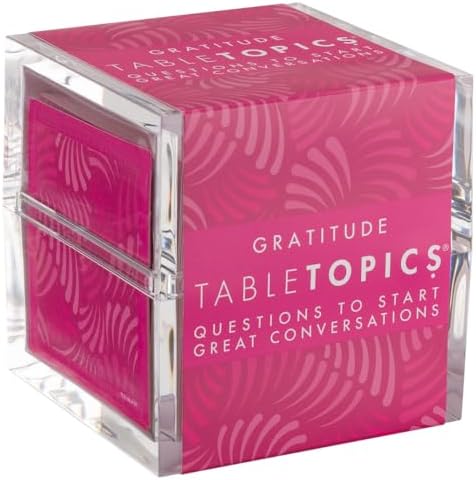
- Sample Questions: What’s the most useful advice about life you’ve been given? Do you prefer to volunteer your time or do…
- Ideal For: Parents, close friends, family, personal reflection, 1 or more players
- Uses: Family dinner, hanging out with friends, relaxing, one-on-one
3) Gratitude Jar Kit
Why it helps
Ritual builds consistency. A jar makes gratitude visible as it fills.
How to use it
- Place jar + colorful slips + pen on a tray.
- Add 1 note per person most nights (no guilt if you miss a day).
- Read a handful on the last Friday of each month.
Design tip
Label it “Good Moments” for kids who find “gratitude” abstract.
Starter slips
“Something kind I noticed…” “A small win today was…” “A quiet moment I loved…”
4) Kindness Challenge Calendar (Reusable)
Why it helps
Doing kind acts builds empathy—the other half of gratitude.
How to use it
- Choose 12–20 simple actions (“write a thank-you note,” “hold the door,” “leave a happy Post-it”).
- Let kids choose the day’s challenge to boost autonomy.
- Celebrate with a high-five ritual rather than rewards.
Display
Hang on the fridge or command center; check off with dry-erase.
5) Uplifting Wall Art (Calm, Age-Neutral)
Why it helps
Visual cues shift atmosphere. A quiet print near the table or entry reminds everyone what the home values.
How to use it
- Choose neutral, modern prints (“Together.” “Grateful for now.” nature photography).
- Keep frames cohesive for a calm look.
- Pair with a small ledge for rotating kids’ art of “good things.”
Micro-ritual
When someone walks past, say one small thing you appreciate out loud.
6) Family Gratitude Game (Board, Bingo, or DIY)
Why it helps
Play disarms resistance. Reflection becomes light and shared.
How to use it
- Weekly family night: shuffle prompt cards or roll a die for categories (people, places, moments, helpers).
- DIY bingo: fill squares with gratitude themes; first bingo shares three specifics.
Tip
Choose games that scale from ages 5–teen so everyone can play.

- Cuteness Overload: Designed by a talented mom, these festive game cards feature an adorable turkey with a fun background…
- Awesome Quality: Forget smaller, chintzier cards printed on flimsy paper. At 5″x 7″ your Thanksgiving Game Cards are big…
- Fill-In Spaces for Details: Fill in spaces give guests room to write in a few words of thanks for each category listed. …
7) Memory Jar with Prompts
Why it helps
Captures micro-memories you’d forget by spring.
How to use it
- Keep a small stack of prompt cards: “A moment that made me laugh,” “I felt brave when…,” “We worked as a team when…”
- Drop notes in after outings, games, or lazy Sundays.
- Read on birthdays, anniversaries, or New Year’s Eve.
Design touch
Use colored slips by person so voices stand out when you read them back.
8) Shared Mindfulness Tools (Calm Kit)
Why it helps
Pairing gratitude with a brief breath or sound cue deepens the moment.
How to use it
- Create a small basket: soft bell or chime, tiny sand timer, affirmation deck, and a pocket journal.
- Ring the bell before reading gratitude notes; take one slow breath together.
- Keep it by the table or on a living-room shelf.
Affirmation examples
“This home notices the good.” “We can do hard things together.”
9) Photo-Thanks Mini Printer or Album
Why it helps
Teaches “show and tell” gratitude with images (great for visual thinkers).
How to use it
- Snap a picture of the week’s “good thing” (grandparent hug, library trip, sunset).
- Print a few monthly and add captions.
- Build a low-pressure “Year of Good” album.
Kid job
Let children choose which photos make the cut—ownership increases buy-in.
10) Dinner Table Gratitude Placemats (Dry-Erase)
Why it helps
Routine embeds the habit without fanfare.
How to use it
- Use simple reusable placemats with a small “Today I’m grateful for…” box.
- Wipe clean after meals; keep markers in a cup nearby.
Alternative
A chalkboard strip or whiteboard near the table works too.
How to start (and keep) a family gratitude ritual
- Choose one anchor time. After dinner, Sunday nights, or school pickup in the car.
- Make it tiny. One sentence, one photo, one note—success beats perfection.
- Rotate leaders. Kids love “tonight I’m host.”
- Expect dry spells. Name it without pressure: “Quiet week. Let’s notice one small thing.”
- Celebrate consistency, not quantity. “We showed up.”
Gift bundles that feel special (and are easy to give)
- The Table Set: Conversation cards + sand timer + small bell on a wooden tray.
- The Cozy Kit: Family journal + two gel pens + soft throw.
- The Jar Bundle: Lidded jar + colorful slips + fine-tip pen + prompt card.
- The Calm Basket: Affirmation deck + mini chime + child-friendly breathing card.
FAQs
Will teens roll their eyes?
Sometimes—and they still absorb the tone of the home. Keep it optional, keep it quick, and invite them to lead once a month.
How often should we do it?
Weekly is sustainable for most families. Add quick daily notes during November or around birthdays.
Religious or secular language?
Use what fits your family. “Grateful for…” and “I appreciate…” are inclusive and effective.
What if someone’s had a hard week?
Name both/and: “It was tough and there was one small bright spot.” Allow passes—silence can be honest gratitude for rest.
How do we include little kids?
Let them draw, paste stickers, or choose the card. Reflect back their words simply.
Gift list at a glance (choose 1–2, not all)
- Family gratitude journal (lay-flat, prompted)
- Conversation cards (age-inclusive)
- Gratitude jar kit (jar + slips + pen)
- Reusable kindness calendar
- Neutral uplifting wall art + frame
- Board or bingo-style gratitude game
- Memory jar with printed prompt cards
- Calm kit: bell/chime + sand timer + affirmation deck
- Mini photo printer or small album
- Dry-erase gratitude placemats / kitchen whiteboard
Final thought
Gratitude gifts aren’t really about the things. They’re about making space for the moments that matter—three minutes of noticing, one sentence of appreciation, a shared laugh over a tiny note pulled from a jar. Start small. Keep it kind. The tradition you build will be the real gift.
Read next:
Winter Classroom SEL Activities
Calming Christmas Gifts for Clients

About the Author
Hi, I’m Eve, a former school counselor with a master’s degree in School Psychology and a passionate advocate for children and families navigating sensory challenges. As a mom of children with sensory sensitivities, I deeply understand the journey special-needs parents face, and I dedicate myself to researching and sharing practical solutions to help children thrive and feel comfortable in their bodies. My goal is also to empower counselors, therapists, and psychologists with creative strategies and supportive resources to enrich their everyday practice. When I’m not writing or exploring new therapeutic approaches, you’ll find me spending quality time with my family and continually seeking inspiration from everyday moments.