A vision board doesn’t have to be loud, overwhelming, or focused on hustle.
For many people, traditional vision boards full of big goals, luxury images, and constant “manifestation pressure” actually increase anxiety rather than reduce it. When your nervous system is already overwhelmed, adding more expectations isn’t supportive.
A mental health vision board is different.
It’s not about forcing positivity or visualizing a perfect future. It’s about gently reminding yourself of what helps you feel safe, grounded, and emotionally balanced — especially during difficult seasons.
In this guide, you’ll learn how to create a mental health vision board that genuinely supports your wellbeing, emotional regulation, and inner stability — not just your goals.
Whether you’re creating a vision board for 2026, looking for vision board ideas aesthetic, or wanting a more mindful approach to manifestation, this article will guide you step by step.
What Is a Mental Health Vision Board?
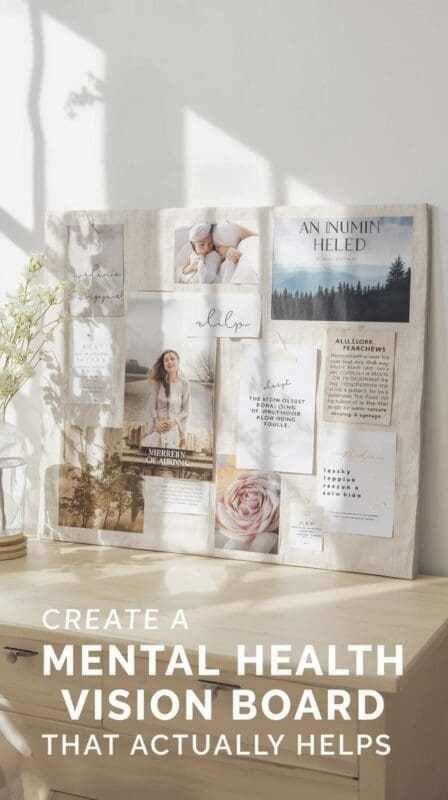
A mental health vision board is a visual tool designed to support emotional wellbeing rather than external achievement.
Instead of focusing on:
- productivity
- success metrics
- external validation
it centers around:
- emotional states
- supportive routines
- inner safety
- values
- realistic self-care
You can think of it as a mental health poster for yourself — something that quietly communicates “this is what helps me feel okay.”
Unlike traditional goal boards, a mental health vision board doesn’t demand change. It offers permission.
Why Vision Boards Can Support Mental Health
Vision boards work not because of magic, but because of neuroscience and psychology.
Here’s why they can be helpful:
- The brain responds strongly to visual cues
- Images activate emotional memory faster than words
- Repeated visual exposure reinforces neural pathways
- Gentle reminders support self-regulation
When done intentionally, a mental health vision board can:
- reduce emotional overwhelm
- increase self-awareness
- support motivation without pressure
- reinforce calming routines
- anchor you during dysregulated moments
This is why mental health awareness tools increasingly include visual elements — posters, charts, visuals, and boards.
Step 1: Set the Right Intention (Before Choosing Any Images)
Before you look for vision board pics or start cutting images, pause.
Ask yourself:
- How do I want to feel more often?
- What supports my mental health right now?
- What feels missing, not what feels impressive?
Helpful intention prompts:
- “I want to feel calmer in my daily life.”
- “I want more emotional safety.”
- “I want gentler mornings.”
- “I want fewer expectations and more stability.”
Your intention sets the tone. Without it, a vision board easily turns into a comparison board.
Step 2: Choose the Format That Feels Supportive
There is no single correct format. Choose what feels accessible.
Popular mental health vision board formats:
- Cork board or pin board
- Paper collage
- Digital vision board
- Printable mental health poster
- Journal-based vision board
Digital boards work especially well if:
- you’re overstimulated by clutter
- you prefer minimal aesthetics
- you want to update it often
Physical boards work well if:
- you enjoy tactile crafting
- you want something visible daily
- creating by hand feels grounding
Step 3: Select Images That Represent Emotional States, Not Just Goals
This is where mental health vision boards differ most.
Instead of asking “What do I want?”, ask:
- “What helps me regulate?”
- “What brings relief?”
- “What feels safe?”
Vision board ideas pictures that support mental health:
- soft light in a quiet room
- slow mornings
- nature scenes
- cozy textures
- calm facial expressions
- restful spaces
- gentle movement
These vision board photos signal safety to the nervous system.
Avoid images that trigger:
- comparison
- urgency
- pressure
- unrealistic expectations
Your board should feel like a deep exhale.
Step 4: Include Mental Health Anchors
A powerful mental health vision board includes anchors — reminders of what helps you cope.
Examples of mental health anchors:
- your therapy tools
- grounding practices
- emotional regulation strategies
- boundaries
- rest cues
You might include images representing:
- journaling
- walking
- deep breathing
- warm drinks
- quiet evenings
- limited screen time
These act as visual coping prompts, especially during stressful moments.
Step 5: Add Words Sparingly (and Carefully)
Words can be powerful — or overwhelming.
Instead of affirmations like:
- “I am always calm”
- “I manifest abundance effortlessly”
Try language that feels believable:
- “I am allowed to slow down.”
- “Rest is productive.”
- “I don’t have to fix everything today.”
- “My mental health matters.”
These phrases align with mental health awareness, not toxic positivity.
Step 6: Create an Aesthetic That Feels Regulating
Pinterest users often search for:
- vision board ideas aesthetic
- vision board ideas pictures
- vision board ideas examples
But aesthetic isn’t about trends. It’s about nervous system comfort.
Calming aesthetics often include:
- neutral or pastel colors
- minimal layouts
- soft lighting
- space between elements
If looking at your board feels cluttered, simplify it.
A mental health vision board should feel:
- quiet
- breathable
- gentle
Step 7: Place Your Vision Board Where It Supports You (Not Pressures You)
Your vision board should be visible enough to remind you — but not so visible that it creates guilt.
Good placement ideas:
- bedroom wall
- inside a journal
- phone lock screen
- digital wallpaper
- private workspace corner
If you ever notice that your board creates pressure instead of comfort, that’s information — not failure.
You’re allowed to change it.
Mental Health Vision Board Ideas by Theme
Emotional Regulation Board
Focus on calm, grounding, stability.
Images:
- nature
- breathing cues
- quiet interiors
Burnout Recovery Board
Focus on rest, boundaries, simplicity.
Images:
- slow mornings
- reduced schedules
- cozy rest spaces
Anxiety Support Board
Focus on safety, predictability, softness.
Images:
- warm lighting
- familiar places
- soothing textures
Vision Board 2026 (Mental Health Focused)
Instead of goals, focus on:
- how you want your days to feel
- what you want less of
- what you want to protect
This makes your vision board 2026 sustainable, not exhausting.
Common Mistakes to Avoid
- Treating a mental health vision board like a productivity tool
- Using images that trigger comparison
- Overloading the board
- Forcing positivity
- Never revisiting or updating it
Your mental health changes. Your board should too.
How Vision Boards Support Manifestation (Without Pressure)
Vision board manifestation doesn’t have to be mystical or forced.
From a psychological perspective:
- repeated exposure increases awareness
- awareness influences choices
- small choices shape outcomes
A mental health vision board helps you notice:
- when you’re pushing too hard
- when you need rest
- what actually supports you
That’s real manifestation — grounded, slow, and human.
Your Vision Board Is Allowed to Be Gentle
A mental health vision board is not a promise to become better.
It’s a reminder that:
- your wellbeing matters
- rest is allowed
- safety comes first
- you don’t have to earn peace
If your board helps you pause, breathe, or soften — it’s already doing its job.

About the Author
Hi, I’m Eve, a former school counselor with a master’s degree in School Psychology and a passionate advocate for children and families navigating sensory challenges. As a mom of children with sensory sensitivities, I deeply understand the journey special-needs parents face, and I dedicate myself to researching and sharing practical solutions to help children thrive and feel comfortable in their bodies. My goal is also to empower counselors, therapists, and psychologists with creative strategies and supportive resources to enrich their everyday practice. When I’m not writing or exploring new therapeutic approaches, you’ll find me spending quality time with my family and continually seeking inspiration from everyday moments.