
Disclosure: This post may contain affiliate links. If you buy through my links, I may earn a small commission at no extra cost to you.
On a cool October afternoon, a student paused with a single amber leaf in her hand. “It’s crunchy and kind of soft at the same time,” she whispered, breathing with its edges as she traced each point. Her shoulders dropped. The classroom noise faded. That tiny moment—that’s mindfulness for kids: noticing one small thing with curiosity until the body remembers how to settle.
Fall makes this easier. Crisp air, rustling trees, warm textures, and cozy routines give us natural anchors. Below you’ll find simple, therapist-designed fall mindfulness activities that feel like play while quietly building self-regulation, attention, and resilience.
Why fall mindfulness works (therapist lens)
- Built-in sensory anchors. Leaves, pinecones, scarves, and warm drinks offer tactile and visual cues that help the nervous system downshift.
- Predictable rhythms. Seasonal rituals (walks, storytime, evening wind-downs) create safety through routine.
- Regulation through movement. Short, rhythmic motions (tracing, stretching, shaking a jar) support vagal tone and calm.
Set-up tips
- Keep practices short (5–10 minutes).
- Offer choices (which leaf, which prompt) for a sense of control.
- Pair each activity with one simple breath cue: in through the nose, out like you’re fogging a window.
1. Leaf Breathing Exercise
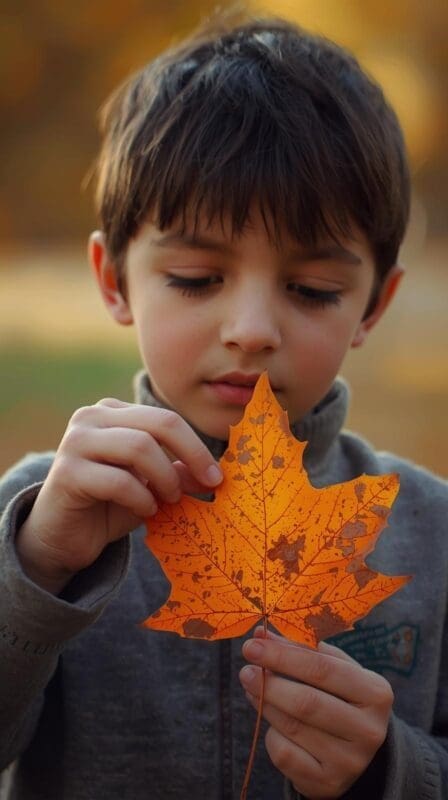
Pick a large autumn leaf. Have children trace the outline with their finger, breathing in as they trace up and out as they trace down.
Picture this: A child traces a maple leaf’s peaks and valleys, inhaling up one edge, exhaling down the next.
How to try: Give each child a leaf or printed leaf outline. Trace slowly: breathe in on the rise, out on the fall, five times around.
Why it helps: A concrete visual slows breathing and anchors attention; the finger-to-leaf contact adds grounding tactile input.
Counselor tip: Ask, “Which edge felt most calming?”—a quick body awareness check-in.
Why it works: Breathing exercises calm the nervous system, while the leaf gives a visual anchor.
2. Gratitude Leaf Pile
As kids jump into a pile of leaves, encourage them to pause and name one thing they’re grateful for with each jump. Laughter, a soft jump into raked leaves—then one whispered thank-you per leap.
How to try: Before each jump, name one small gratitude. Indoors, swap for paper leaves tossed into a basket.
Why it helps: Brief bursts of joy paired with naming positives build a gratitude habit linked to better mood regulation.
Adaptation: Use a “quiet jump” or knee bend for sensory-sensitive kids.

3. Pumpkin Mindfulness Jar
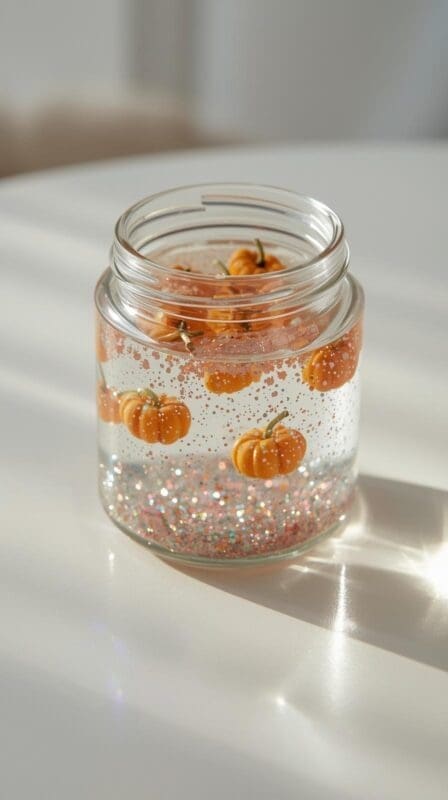
Fill a jar with water, glitter, and small pumpkin confetti. Kids shake the jar and watch until everything settles, just like calming thoughts settling down.
Orange glitter swirls with tiny pumpkin confetti, then settles like a snow globe of calm.
How to try: Fill a clear bottle with water, a dash of glycerin, fine glitter, and confetti. Shake, watch to stillness, breathe slowly.
Why it helps: Visual focus + slow time = co-regulation. Watching settle mirrors thoughts settling.
Safety: Hot-glue the lid if used with young children.


4. Acorn Listening Game
Sit quietly outdoors with a small pile of acorns. Invite children to close their eyes and count how many different sounds they can hear — wind, birds, crunching leaves. Eyes closed, acorn in hand, counting sounds—wind, birds, footsteps, distant chatter.
How to try: Sit outside or near an open window. Quiet for one minute. Each child shares two sounds they heard.
Why it helps: Tunes selective attention; anchors to the present without pressure to “clear the mind.”
Counselor tip: Prompt “near sound, far sound” to widen awareness.
Benefit: Encourages attention and deep listening skills.

5. Fall Senses Walk
Take a mindful walk and focus on the five senses. What do the leaves smell like? How do pinecones feel? What colors do you see in the trees? Slow steps on a leaf-lined path, naming one thing to see, hear, feel, smell.
How to try: Take a 5–10 minute walk. Bring a small “senses card.” Log finds in a tiny notebook.
Why it helps: Gentle bilateral movement + sensory noticing supports regulation and curiosity.
Classroom swap: A windowsill “nature tray” for touch-and-tell.
Tip: Record answers in a “fall senses journal.”

6. Cozy Breathing with a Scarf
Give each child a soft scarf. As they breathe in and out, they wave the scarf slowly up and down like a leaf drifting in the wind. Soft scarf rises and falls like a drifting leaf.
How to try: With a lightweight scarf, inhale and lift, exhale and lower in slow waves for one minute.
Why it helps: Adds rhythm and proprioceptive feedback to breath; calming for wiggly bodies.

- BRIGHT COLORS JUGGLING SCARVES: Play scarves set of 24 beautiful color scarves includes: red, orange, yellow, green, roy…
- PREMIUM DANCE SCARF: These dancing scarves are made of thin and skin-friendly fabric with fine stitches, nice finished e…
- WIDE VARIOUS APPLICATION : These silk scarfs for kids are suitable for dancing with in music class, juggling, props of k…
7. Apple Tasting Meditation
Offer slices of apple. Ask children to notice the texture, crunch, sweetness, and smell before eating slowly. A crisp slice examined like treasure: color, scent, first crunch, slow chew.
How to try: Observe before tasting. One bite: notice texture, temperature, flavor. Describe with three words.
Why it helps: Mindful eating builds interoception (body awareness) and slows impulsivity.
Allergy-safe: Use crackers or pear slices if needed.
Therapeutic twist: Builds mindful eating habits and awareness of the body.

8. Pinecone Gratitude Hunt
Each child finds a pinecone and names one thing they’re thankful for. Place pinecones in a basket as a “gratitude collection.” Little hands gather pinecones, each named for one small thanks.
How to try: Collect 3–5 pinecones. For each, say a gratitude and place in a “thankful basket.”
Why it helps: Tangible tokens of positives strengthen recall of good moments. Combines nature play with positive reflection.
Therapist tip: Read two gratitudes aloud to close a session.

9. Fall-Themed Yoga Poses
Practice simple poses with seasonal names: “tree pose,” “falling leaf stretch,” “pumpkin curl.” Tree, falling leaf stretch, curling pumpkin rest pose.
How to try: Flow through 4–5 poses slowly with breath cues. End in “hibernation” (child’s pose).
Why it helps: Rhythmic, named movement discharges energy and supports self-regulation.
Adaptation: Chair-based versions for classrooms.
Benefit: Movement-based mindfulness reduces restlessness while supporting self-regulation.

10. Nature Mandalas
Collect leaves, twigs, acorns, and flowers. Arrange them into circular mandalas on the ground or paper plates. Circles of leaves, acorns, and twigs arranged into quiet symmetry.
How to try: Gather simple materials. Build a circle from center out. Snap a photo; return items to nature.
Indoor option: Paper plates + paper shapes.
Why it works: The repetitive, creative pattern-making calms the mind and invites focus..

11. Candle Flame Visualization (Flameless Candle)
Use an unscented flameless candle in a dim room. Ask kids to watch the soft glow, take slow breaths, and imagine their worries melting away. Dim lights, soft glow, three slow breaths, shoulders soften.
How to try: Use a flameless candle. Gaze softly at the light for 60–90 seconds while breathing slowly.
Why it helps: Visual stillness encourages physiological stillness; great for transitions.
Safety: Avoid scent if sensitivities are present.
Tip: Especially helpful before bedtime or at the end of therapy sessions.

12. Autumn Feelings Chart
Create a tree poster with blank leaves. Each day, kids pick or draw a leaf with an emoji face (😊 😢 😡 😴 🤩) that matches their feelings. A poster tree filled with leaf-faces from calm to stormy.
How to try: Kids choose or draw a leaf that matches their feeling and place it on the tree during check-in. If you want to skip cutting shapes, paper leaf cutouts can make repeated classroom use quicker.
Why it helps: Externalizes emotions; builds vocabulary and norming around feelings.
Counselor tip: Add “I need” stems under the tree (space, water, movement).
Therapeutic value: Gives kids a concrete way to identify and express emotions.

13. Gratitude Garland
Have children write or draw what they’re thankful for on paper leaves. String them into a garland for the classroom or therapy office. A string of paper leaves across a doorway, each with a small drawing or word of thanks.
How to try: Write or sketch one gratitude per leaf. String weekly; read aloud on Fridays.
Why it helps: Makes gratitude visible and shared—a classroom climate cue.
Inclusive language: “Good things” works for younger kids.

14. Falling Leaf Visualization
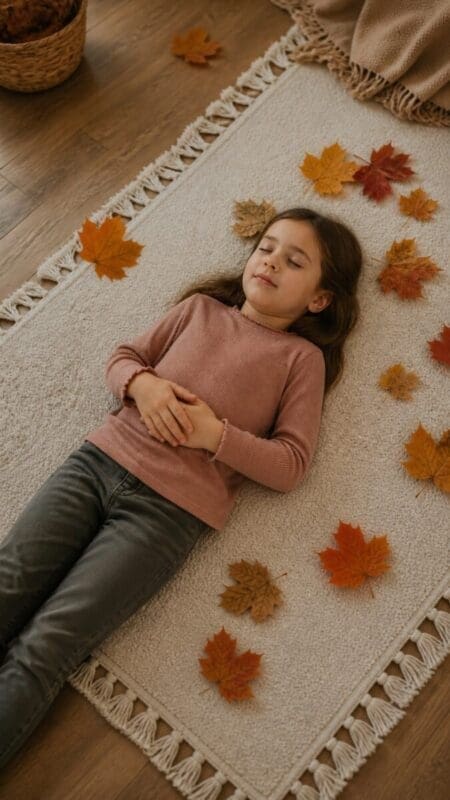
Ask kids to imagine themselves as a leaf floating down gently from a tree. Guide them to breathe slowly as they “drift” to the ground. Eyes closed, a gentle descent from branch to ground, breath matching the float.
How to try: Guide a two-minute script: inhale as you rise on a breeze, exhale as you float down.
Why it helps: Imagery + paced breath reduces physiological arousal.
Adaptation: Trace a paper leaf in the air while breathing.
Benefit: A simple guided visualization that reduces stress.
15. Hot Chocolate Mindfulness
Pretend to hold a warm mug of hot chocolate. Breathe in slowly to “smell” it, then breathe out slowly to “cool it.” Repeat several times. Hands cupped like a mug, breathe in “steam,” breathe out to “cool.”
How to try: Three slow rounds: smell, cool, sip (pretend swallow). Optionally pair with warm water in a safe cup.
Why it helps: Playful, seasonal breath cue sticks in memory for later self-soothing.

Leading fall mindfulness with confidence
- Keep it brief. Five focused minutes beat fifteen restless ones.
- Use props. Leaves, scarves, jars, and cards make mindfulness concrete.
- Offer choice. “Leaf breathing or candle calm today?”
- Model it. Do the activity with them; co-regulation starts with you.
- Normalize restarts. “Brains wander. We notice and come back.”
Quick materials list (optional, low-cost)
- Real or paper leaves, pinecones, twigs
- Clear bottles, fine glitter, glycerin
- Lightweight scarves
- Flameless candle
- Paper, markers, string for garlands
- Small notebook for “senses walk” notes
FAQs
Can preschoolers do this?
Yes—use very short, sensory-heavy versions (30–90 seconds) and more modeling.
Do I need special supplies?
No. Most activities use everyday fall items or simple classroom materials.
What about neurodivergent learners?
Offer visual choices, reduce noise where possible, avoid scented items, and provide a movement alternative for any seated activity.
Can I do these in a classroom?
Absolutely. Use them as warm-ups, transitions, or end-of-day resets. Chair-based versions work well in tight spaces.
How do I know it’s working?
Look for micro-shifts: slower speech, softer shoulders, improved transitions. Consistency beats intensity.
Conclusion
Fall gives us a beautiful toolkit: color, texture, breath, and ritual. When we let kids explore these mindfully—one leaf, one breath, one quiet game at a time—we teach their bodies how to find calm on purpose. Choose two or three activities to start, repeat them weekly, and watch small practices turn into steady skills.
Read next:
Therapy Office Winter Decor Ideas
Winter Classroom SEL Activities
Calming Christmas Crafts for Kids

About the Author
Hi, I’m Eve, a former school counselor with a master’s degree in School Psychology and a passionate advocate for children and families navigating sensory challenges. As a mom of children with sensory sensitivities, I deeply understand the journey special-needs parents face, and I dedicate myself to researching and sharing practical solutions to help children thrive and feel comfortable in their bodies. My goal is also to empower counselors, therapists, and psychologists with creative strategies and supportive resources to enrich their everyday practice. When I’m not writing or exploring new therapeutic approaches, you’ll find me spending quality time with my family and continually seeking inspiration from everyday moments.

