
This post may contain affiliate links, including Amazon Associate links. If you make a purchase through these links, I may earn a small commission at no extra cost to you.
The Pinterest version of a homework station is usually beautiful.
There is a perfectly clean desk, matching pencil cups, a carefully color-coded wall calendar, perhaps a small plant, and just enough stationery to make homework look almost relaxing.
Real homework with a child who has ADHD may look very different.
The child sits down, realizes the pencil is missing, gets up to find one, notices something interesting on the way, returns without the pencil, remembers they need a ruler, asks where the homework sheet is, decides the chair is uncomfortable, and suddenly twenty minutes have passed before the first problem has been started.
That does not mean your child needs a stricter desk.
It may mean the homework system is asking them to manage too many things at the same time.
Homework can require organization, planning, remembering materials, estimating time, shifting between tasks, sustaining attention, and eventually getting finished work back into the school bag. Those steps can be particularly difficult for children with ADHD. CHADD notes that homework problems for children with ADHD often involve not only completing the work itself but also knowing what was assigned, bringing the necessary materials home, planning the work, staying with it, and turning it in afterward.
A helpful ADHD homework station therefore does not have to be one perfect desk in a silent bedroom.
It can be a kitchen-table setup near a parent. It can include a portable homework caddy. It can allow standing for some tasks and sitting for others. It can be quiet, or it may work better with predictable background sound.
The right environment is the one that removes unnecessary friction for your particular child.
Here are 15 ADHD homework station ideas you can adapt to your home, your available space, and the way your child actually works.
Before You Buy a Desk, Figure Out What Is Making Homework Hard
It is easy to assume that a better desk will create better homework habits.
Sometimes it helps. Sometimes the desk is not the problem at all.
Before buying anything, observe homework for several days and ask a more useful question:
Where does the process break down?
Does your child struggle to start?
Do they constantly leave to find supplies?
Do they lose assignments between school and home?
Do they become distracted by siblings, toys, or movement around them?
Do they need frequent help and repeatedly walk away from the desk to find you?
Do they become physically restless after sitting for a short period?
Do finished assignments somehow disappear before the next morning?
The American Academy of Pediatrics notes that there is no single ideal homework setting for every child with ADHD. Some children may work inefficiently in an isolated bedroom and do better at a kitchen table where there is some activity nearby.
CHADD similarly recommends creating an organized and comfortable homework area but notes that this could be a desk, kitchen table, or even a floor space. The useful environment is one that reduces unnecessary distraction while still allowing the amount of adult support the child needs.
So begin with the problem, not the furniture.
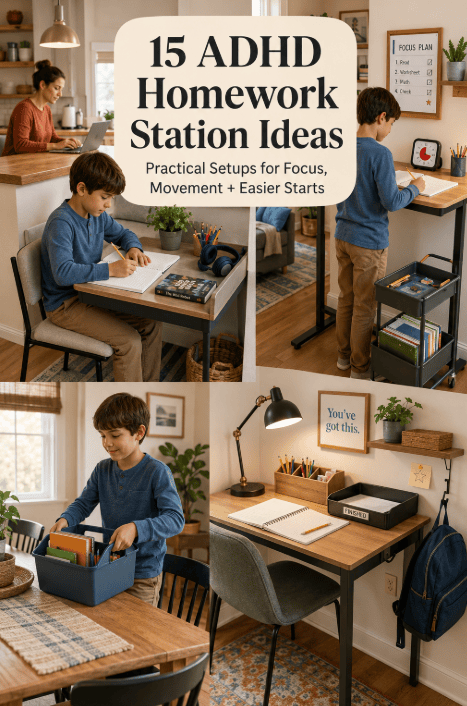
1. Create a Parent-Nearby Homework Station
Some children work better when they know an adult is accessible.
Instead of placing the homework desk in a bedroom at the opposite end of the house, create a work area near the kitchen, dining room, or family workspace.
The parent does not need to sit beside the child for the entire assignment. The benefit may simply be reducing the number of transitions required to ask:
“Can you explain this?”
“Where is my calculator?”
“Am I doing this correctly?”
A small table beside the kitchen may therefore work better than an expensive desk upstairs.
Keep the space visually defined with a placemat, desk pad, small supply caddy, or dedicated chair. When homework is finished, the materials can be put away and the table can return to family use.
Best for: children who frequently seek adult help or struggle to work when isolated.
You may not need to buy: a separate desk. A consistent seat at your existing table may be enough.
2. Build a Low-Distraction Homework Desk
Other children genuinely do become pulled away by everything around them.
If your child stops working whenever someone walks past, the television turns on, or a sibling begins playing nearby, a quieter homework location may be useful.
Position the desk so the child is not directly facing:
- A toy shelf
- A busy hallway
- A television
- An open doorway
- A visually crowded wall
Keep only current materials on the work surface.
This does not mean stripping the room of personality. A calm wall color, one piece of artwork, a lamp, and a few meaningful objects can still make the space inviting.
The goal is simply to reduce the number of competing signals demanding attention.
Best for: children who are easily diverted by surrounding activity.
Simpler alternative: turn an existing table toward a quieter wall during homework.
3. Use a Portable Homework Caddy
A portable homework caddy may be one of the most practical ADHD homework organization tools because it reduces repeated searching.
Keep basic supplies together:
- Pencils
- Erasers
- Highlighters
- Scissors
- Glue
- Ruler
- Sticky notes
- Calculator
- Pencil sharpener
- Charger when appropriate
The entire container moves with the child.
Homework at the kitchen table tonight? Bring the caddy.
Reading on the sofa tomorrow? The supplies are still together.
A portable station is especially useful when the child does not work in one fixed location. CHADD specifically suggests portable baskets or similar homework stations for children who prefer to work at a table, sofa, or floor area.
Choose a caddy with broad compartments rather than twenty tiny sections that require precise sorting.
The purpose is to find the pencil quickly, not to create a miniature office-supply showroom.
4. Try a Standing Homework Station
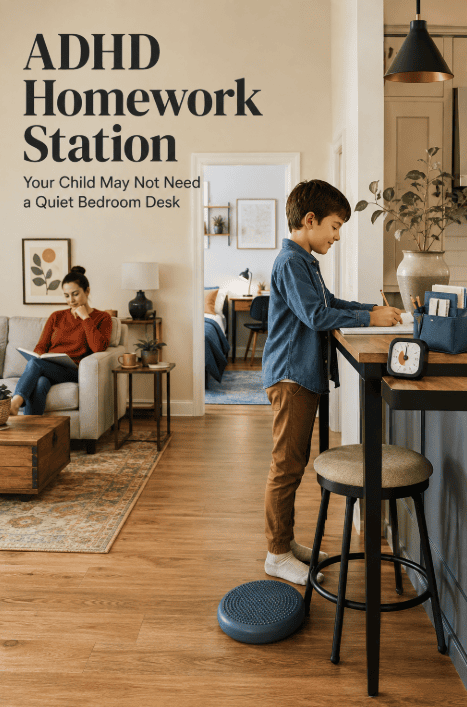
Some homework tasks do not require sitting.
A child may be able to:
- Read vocabulary cards while standing
- Practice spelling at a counter
- Review multiplication facts while moving
- Read aloud while pacing slowly
- Complete a worksheet at a higher work surface
CHADD notes that some children work better when they are able to stand or move while doing activities such as reading, memorizing, or being quizzed.
This does not mean every child with ADHD needs a standing desk.
Test the idea before investing.
A kitchen island, dresser-height surface, or counter may tell you whether standing genuinely helps.
5. Create a Sit-or-Stand Homework Setup
Instead of deciding whether your child is a “sitting learner” or “standing learner,” allow both.
For example:
- Written math at the desk
- Spelling practice standing
- Reading in a comfortable chair
- Flash cards while walking
- Final worksheet back at the table
This approach recognizes that different tasks place different demands on the child.
The homework station becomes a homework system, not one chair the child is expected to remain in for an hour.
If you eventually purchase an adjustable desk, check stability, safe height ranges, and whether the child can use it comfortably. But first test flexible positioning with furniture you already own.
6. Keep the Desk Visually Simple
A homework desk can become a magnet for interesting objects.
Five pencil cups, decorative lights, toys, collectible figures, colorful stationery, a clock, photographs, a calendar, a pinboard, and a spinning organizer may look wonderful—but they also create many things to touch, look at, and rearrange.
Try keeping only the tools needed for the current assignment visible.
For example:
On the desk: workbook, pencil, eraser, water.
Nearby but contained: additional supplies.
Stored elsewhere: toys, craft collections, extra stationery.
Minimal does not need to mean beige or empty. Your child can still choose a desk mat, lamp, or organizer they genuinely like.
The question is simply:
Does this object help homework happen, or does it compete with homework?
7. Add a Short Visual Homework Sequence
“Do your homework” contains many steps.
A visual sequence can make the process more concrete:
- Check assignments
- Choose the first task
- Get supplies
- Complete the work
- Put finished work in the school folder
For a younger child, use pictures.
For an older child, a small dry-erase checklist may feel more age-appropriate.
Keep it short. A detailed 25-step chart can become another assignment.
The visual schedule should reduce the amount the child must remember rather than create additional instructions to manage.
This will connect naturally to the upcoming Eveyou guide on visual schedules for kids with ADHD, where the topic can be explored in more depth.
8. Give Homework Supplies One Predictable Home
Organization becomes easier when the child does not need to ask:
“Where do the scissors go?”
Keep broad categories rather than complicated sorting.
You might have:
Writing: pencils, pens, highlighters
Paper: loose paper, notebooks, graph paper
Tools: scissors, ruler, calculator
Technology: charger, headphones, device accessories
School return: finished assignments
This approach mirrors the same low-friction principle used in ADHD-friendly kids’ room organization: the system needs to be simple enough to use repeatedly, not simply attractive when freshly organized.
If several children share supplies, consider one family homework cart rather than duplicating everything.
9. Create a Finished-Homework Launch Basket
Completing an assignment is not the final step.
The assignment still has to return to school.
Create one clearly defined place for finished work.
This could be:
- A document tray
- A vertical wall file
- A folder
- A shallow basket
- A “return to school” section beside the backpack
The routine becomes:
Finish → folder → backpack.
Do not leave completed homework on the desk “to pack later” if later is consistently where the system fails.
CHADD highlights lost or misplaced completed work as a common homework problem and recommends systems such as designated folders that travel between home and school.
Connect this system to your morning routine for kids with ADHD so the school launch station and homework station work together rather than existing as separate systems.
10. Use a Timer as Information, Not Pressure
Timers can help make time visible.
A child might use one to answer:
“How long will I work before checking in?”
or:
“How much time remains before the planned break?”
CHADD recommends timers or silent clocks as possible supports for distinguishing work time from break time and suggests that some children may benefit from brief movement or snack breaks.
But a timer should not automatically become a race.
Instead of:
“You have ten minutes to finish this.”
Try:
“We’ll work for ten minutes and then see what you need.”
A visual timer may help some children understand passing time because the remaining period is visible rather than abstract. An ordinary kitchen timer may work perfectly well for another child.
Choose the simplest tool the child actually notices.
11. Build Movement Into the Homework Area
Movement does not have to mean leaving homework completely.
Create a nearby place for a short reset:
- A clear area to stretch
- A hallway for one brief walk
- A sturdy place to stand
- A few simple movement cards
- A spot for wall pushes
- A water station
Keep breaks defined enough that “I need to move” does not accidentally become forty minutes of unrelated play.
For example:
Finish these five problems, then choose one movement break.
or:
When the timer ends, take five minutes to move and get water.
The length and frequency should be adapted to your child rather than following a rigid social-media formula.
12. Give Reading Its Own Comfortable Spot
Not every homework task needs to happen at a desk.
A child might read more comfortably:
- In a supportive chair
- On a floor cushion
- On the sofa
- At the end of the bed
- In a quiet reading corner
Written work can stay at the table while reading happens somewhere else.
This distinction can reduce battles about remaining in one physical position when the assignment itself does not require it.
If reading turns into wandering or play, bring it back to a more structured area. The purpose is flexibility, not removing all expectations.
13. Create a Small-Space Homework Station
You do not need a dedicated study room.
In a small bedroom or apartment, try:
- A narrow desk
- Wall-mounted file storage
- One rolling cart
- A portable supply caddy
- A folding desk
- A shelf beside the dining table
- Vertical book storage
- Under-desk hooks for a school bag
Prioritize the most-used materials.
A tiny desk buried beneath organizers is less functional than a clear table with one nearby caddy.
For a particularly small room, the homework “station” might simply be a rolling cart parked beside the kitchen table during homework and moved away afterward.
This setup also creates a strong link to your broader ADHD kids’ room organization guide, especially for families who need one bedroom to support sleeping, dressing, play, and schoolwork.
14. Design a Shared-Sibling Homework Setup
Shared homework spaces introduce another layer of difficulty.
One child may need silence while another talks through every math problem.
One may require movement while another becomes distracted by it.
Instead of expecting the children to use the same setup identically, give each child a defined area.
Possible solutions include:
- Separate supply caddies
- Different ends of the table
- Individual document trays
- Different homework start times
- A quiet backup location
- Separate headphones when appropriate
- A portable divider used only when genuinely helpful
Keep expectations realistic. The goal is not to eliminate every sound or interaction between siblings but to prevent predictable conflict from becoming part of homework every evening.
15. End With a Two-Minute Homework Reset
A homework station is most useful when tomorrow’s child does not inherit today’s chaos.
Create a very short closing routine:
- Finished work goes into the correct folder.
- Folder goes into the backpack or launch station.
- Supplies return to the caddy.
- Charger is plugged in if needed.
- Work surface is cleared.
This should take only a few minutes.
If the routine requires reorganizing every drawer, sharpening twelve pencils, color-coding tomorrow’s assignments, and wiping the entire desk, it will probably not survive a tired Wednesday evening.
The most important step is getting completed work back into the school system.
A Sample ADHD-Friendly Homework Flow
The station becomes much more useful when it fits into a predictable after-school sequence.
A realistic flow might look like this:
Step 1: Arrive Home and Reset
Your child may need food, movement, quiet time, or connection before beginning homework.
Do not assume homework should start immediately just because school has ended.
If homework consistently becomes explosive at one particular time, consider whether fatigue, hunger, medication timing, transition difficulty, or accumulated school stress may be contributing. HealthyChildren recommends observing the child’s daily patterns and adjusting routines to the individual when possible.
Step 2: Check What Actually Needs to Be Done
Open the planner, online portal, homework folder, or teacher instructions.
Do not begin by asking:
“Do you have homework?”
A child who has difficulty remembering assignments may sincerely answer “I don’t know.”
Look at the external system.
Step 3: Choose the First Task
Do not place five assignments on the table simultaneously.
Choose the first one.
Depending on the child, beginning with the shortest task may create momentum, while another child may prefer to complete the hardest assignment before becoming tired.
Step 4: Gather Only the Needed Supplies
Bring the workbook, pencil, and calculator if needed.
Leave unrelated supplies in the caddy.
Step 5: Work, Check In, and Take Planned Breaks
Use whatever work-and-break rhythm fits the child.
There is no universal ADHD interval.
Step 6: Finish the Entire Homework Cycle
Do not stop at “assignment completed.”
Complete:
Finished work → school folder → backpack → launch station.
That final transition may be just as important as the desk itself.
Shop by the Homework Problem
A product is useful when it removes a genuine obstacle—not simply because it is marketed as an ADHD essential.
Supplies Keep Disappearing
Consider:
- Portable homework caddy
- Broad-compartment desk organizer
- Pencil container
- Small rolling cart
Low-cost alternative: repurpose an existing basket or utensil caddy.
Finished Assignments Get Lost
Consider:
- Vertical document holder
- Finished-work tray
- Clearly colored folder
- Wall file near the backpack
Low-cost alternative: one labeled envelope or folder.
The Child Needs to Work in Different Places
Consider:
- Portable caddy
- Lap desk
- Lightweight clipboard
- Rolling supply cart
Low-cost alternative: a sturdy tray or basket already at home.
Time Feels Invisible
Consider:
- Visual timer
- Simple desk clock
- Dry-erase schedule
Low-cost alternative: a kitchen timer or phone timer managed by the parent.
The Work Surface Becomes Too Cluttered
Consider:
- Closed drawer organizer
- Small nearby storage cart
- Vertical paper organizer
- Cable management
The simplest solution may still be removing unnecessary items rather than purchasing more organizers.
Lighting Makes the Space Uncomfortable
A simple adjustable task lamp may help when the homework area is dim.
Look for stable construction, easy controls, and a position that lights the work without shining directly into the child’s eyes.
When Homework Difficulties Need More Than a Better Setup
A homework station is environmental support. It is not ADHD treatment, and it cannot solve every academic difficulty.
Persistent homework problems may involve:
- Difficulty understanding the academic material
- Learning differences
- Significant anxiety
- Sleep problems
- Problems recording assignments at school
- Excessive homework demands
- Medication timing or side effects
- Emotional exhaustion after the school day
- A mismatch between accommodations and the child’s needs
If homework consistently requires hours, causes intense distress, or appears far beyond what the child can manage even with appropriate support, talk with the teacher and the child’s healthcare or educational professionals.
Homework intervention may need to involve both home and school because the process begins when the assignment is given and ends only when completed work is successfully returned. CHADD’s homework guidance emphasizes this broader chain rather than treating the problem as simply a child failing to sit still at home.
Final Thoughts
The best ADHD homework station may not look like a traditional homework station at all.
It might be a kitchen-table seat beside a parent.
It might be a small bedroom desk facing a quiet wall.
It might be a homework caddy that moves from room to room.
It may allow standing for spelling, sitting for math, and reading in a comfortable chair.
What matters is not whether the setup photographs beautifully.
What matters is whether it reduces the number of obstacles between:
“I have homework”
and
“My finished homework is back in my backpack.”
Start by watching where the process repeatedly breaks down. Then change one thing.
Move supplies closer.
Reduce the amount visible on the desk.
Create a finished-work folder.
Try working closer to a parent.
Allow appropriate movement.
Add a short visual sequence.
A child who struggles with organization does not necessarily need a more elaborate organization system. Very often, they need a simpler one.
And when the system fits the child rather than expecting the child to fit the system, homework may become a little easier for everyone.

About the Author
Hi, I’m Eve, a former school counselor with a master’s degree in School Psychology and a passionate advocate for children and families navigating sensory challenges. As a mom of children with sensory sensitivities, I deeply understand the journey special-needs parents face, and I dedicate myself to researching and sharing practical solutions to help children thrive and feel comfortable in their bodies. My goal is also to empower counselors, therapists, and psychologists with creative strategies and supportive resources to enrich their everyday practice. When I’m not writing or exploring new therapeutic approaches, you’ll find me spending quality time with my family and continually seeking inspiration from everyday moments.

