
Some school counselor office wall decor is simply pretty to look at.
But the best kind does something more.
It helps a student pause at the doorway and feel, even before a conversation begins, that this is a place where they are welcome. It gives children something gentle to notice when they are nervous. It offers words they can borrow when their own words are still hard to find.
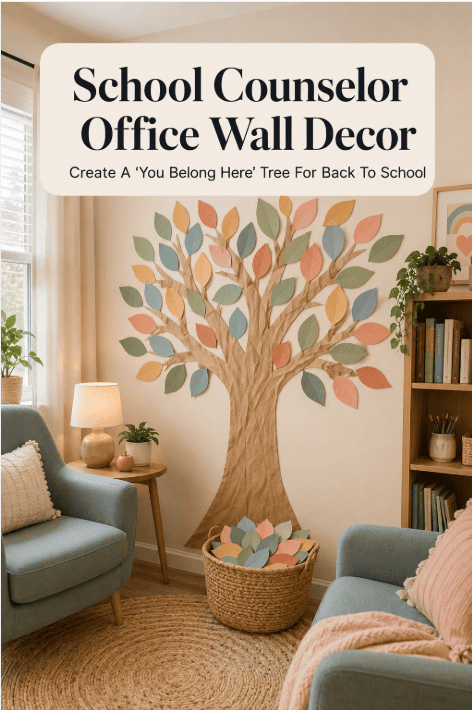
That is why a “You Belong Here” tree can be such a beautiful back-to-school idea for a school counseling office, classroom calm corner, hallway display, or child therapy space.
It is warm, visual, easy to personalize, and deeply practical. Each leaf can hold a message, coping skill, student reflection, friendship prompt, or reminder of support. It turns a blank wall into an interactive SEL display that grows with your students throughout the school year.
If you are refreshing your school counselor office wall decor before students return, this project is a meaningful place to start.
This post may contain affiliate links, including Amazon and selected partner links. If you make a purchase through these links, I may earn a small commission at no extra cost to you.
Why a “You Belong Here” Tree Works So Well
A school counselor’s office is not just a room for problem-solving. It is often a place where students come when they feel uncertain, overwhelmed, lonely, angry, anxious, or misunderstood.
Some students arrive ready to talk. Others walk in silently, look at the floor, and need several minutes before they can say what happened. Some children are still learning how to name emotions. Others know exactly what they feel but do not yet feel safe enough to share it out loud.
A belonging tree works because it communicates several supportive messages at once:
- This space is for you.
- Feelings are allowed here.
- You are part of the school community.
- You can ask for help.
- You can choose a helpful next step.
- Growth takes time.
The tree image also works beautifully with children because it is familiar and flexible. Trees can represent growth, roots, safety, seasons, change, kindness, courage, and connection.
A child may not want to say, “I feel anxious about starting school,” but they may be able to choose a leaf that says, “You can be brave and nervous at the same time.”
That small choice can become the beginning of a conversation.
A “You Belong Here” tree is also reusable. You can use the same display in August for back-to-school belonging, in fall for gratitude, in winter for encouragement, in spring for growth, and at the end of the year for reflection.
Decide What Your Tree Is For
Before cutting paper or printing leaves, decide what role this display will play in your space.
Your tree might be:
- a back-to-school welcome display
- a belonging and inclusion activity
- a coping-skills wall
- a kindness and friendship board
- a student reflection display
- a calm-down corner visual
- a seasonal SEL bulletin board
For example, if your goal is helping students feel welcome at the beginning of the year, your leaves might focus on belonging messages and school support. If your goal is emotional regulation, your leaves might include coping skills, grounding strategies, and calming choices.
Choosing a clear purpose keeps the display from becoming cluttered or confusing.
A simple back-to-school focus might be:
You Belong Here: A tree of welcome, support, and small brave steps.
Supplies You Need
You can make this project as simple or polished as you like. Start with what you already have, then add only the supplies that make the display easier to create and reuse.
Basic Supplies
- Brown kraft paper or bulletin board paper for the trunk
- Colored cardstock or construction paper for leaves
- Scissors or a paper cutter
- Removable wall adhesive
- Glue dots or tape
- Markers or paint pens
- Large printed or handwritten title letters
- Optional bulletin board border
- Optional laminating sheets
- Optional leaf template
- Optional mini clothespins or Velcro dots
- Optional basket or envelope for blank leaves
If you are decorating on a tight school budget, do not feel pressured to buy a full set of matching materials. Kraft paper, construction paper, and a black marker can still create a beautiful display when the message is thoughtful.
Helpful Extras
If you want the tree to look softer and more intentional, consider adding muted cardstock colors, faux greenery, a woven basket for extra leaves, dry-erase pockets for reusable prompts, or small battery-operated fairy lights if permitted by your school.
Safety matters. If you use lights, cords, adhesive, or small decorative pieces, follow your school’s policies and make sure everything is secure, age-appropriate, and away from walkways.
Choose a Calm Color Palette
Your “You Belong Here” tree does not need to be bright primary colors to feel child-friendly.
In a school counselor office, softer colors often feel warmer and more regulating. They also photograph beautifully for Pinterest-style visuals while still feeling professional in a real school space.
Try one of these palettes:
Soft back-to-school: sage green, muted peach, warm cream, dusty blue, and light brown kraft paper.
Cozy autumn: terracotta, mustard, olive green, cream, and soft rust.
Calm counseling office: sage, beige, soft blue, warm gray, and natural wood tones.
Cheerful elementary: coral, butter yellow, mint green, sky blue, and soft lavender.
If your office already has a color palette, repeat those colors in the leaves so the display feels like part of the room rather than a separate project.
How to Make the Tree Trunk and Branches
The tree does not need to be perfect. A slightly handmade look can feel warmer and more inviting than something overly polished.
Step 1: Choose the Wall Space
Pick a spot students can see easily when they enter your office.
Good locations include:
- near the office entrance
- beside a calm-down corner
- behind or beside the seating area
- above a low shelf
- on a bulletin board
- near your feelings check-in area
- in a hallway counseling display
Avoid placing the tree where students will constantly brush against it, where it blocks important information, or where it creates visual clutter near confidential materials.
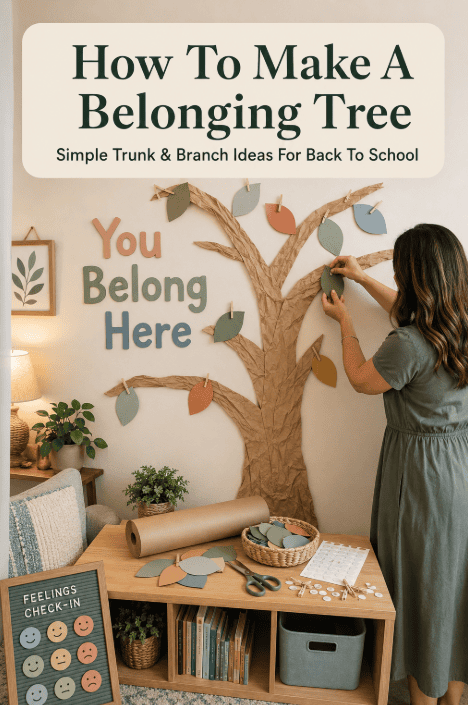
Step 2: Create the Trunk
Cut a long, slightly uneven tree trunk from kraft paper or brown bulletin board paper. You can keep it flat and simple or add wood-grain lines with a marker.
For a more textured look, wrinkle the kraft paper slightly before attaching it to the wall. This gives it a natural bark-like feel.
Step 3: Add Branches
Cut long branch shapes and extend them upward and outward from the trunk.
Keep the branches wide enough to hold leaves, but not so large that the tree takes over the room. If you have a small office, a half-tree growing from one corner can look beautiful and save space.
Step 4: Add the Title
Place your title above, beside, or across the tree.
Try phrases like:
- You Belong Here
- We Grow Together
- Kindness Grows Here
- Small Steps Count
- Your Feelings Are Welcome Here
- This Is a Place to Grow
- Take What You Need
For back to school, “You Belong Here” is the strongest and clearest message. It speaks directly to the emotional question many children carry into the first weeks of school: Is there a place for me here?
Make Leaf Prompts Students Can Use
The leaves are the heart of the display.
You can use prewritten leaves, student-created leaves, removable leaves, or a mix of all three. The best option depends on where the display will be and how much privacy students need.
For a school counseling office, a balanced tree might include three types of leaves:
- Belonging leaves
- Coping skill leaves
- Kindness or reflection leaves
Use one color for each category so students understand the display quickly. For example, green leaves can be for belonging, blue leaves for coping skills, and peach leaves for kindness.
Belonging Leaf Prompts
Back-to-school season is full of quiet questions for children.
Will I have a friend?
Will my teacher understand me?
Will I know what to do?
Will I be okay if I miss home?
Will I belong here?
Belonging leaves can gently answer those questions.
Use prompts such as:
- You are welcome here.
- You do not have to be perfect to belong.
- There is a place for you in this school.
- Your voice matters.
- You can ask for help.
- You are more than one hard moment.
- You are allowed to take your time.
- You can try again tomorrow.
- New routines take practice.
- Someone is glad you are here.
- You can be brave and nervous at the same time.
- It is okay to start small.
- You belong even when you feel unsure.
- You do not have to figure everything out alone.
- This room is a place to pause and breathe.
For younger students, keep the wording simple. For older students, use more subtle, respectful phrases that do not feel too babyish, such as “Take one small step” or “You are more than one hard day.”
Coping Skill Leaves
A “You Belong Here” tree can also become a gentle coping-skills display.
Each leaf can offer one small action a student can try when they feel overwhelmed, worried, angry, or stuck.
Try coping skill leaves such as:
- Take five slow breaths.
- Put both feet on the floor.
- Name five things you can see.
- Ask for a break.
- Draw what you feel.
- Squeeze and release your hands.
- Get a drink of water.
- Use a quiet fidget.
- Stretch your shoulders.
- Say, “I can take one small step.”
- Ask a trusted adult for help.
- Count backward from 20.
- Notice where the feeling is in your body.
- Take a slow walk.
- Write one worry down.
- Choose one thing you can control.
- Hold something smooth or soft.
- Ask, “What do I need right now?”
- Try again after a pause.
- Remember one place where you feel safe.
Place coping leaves lower on the tree so students can physically choose one when needed. If you laminate the leaves and add Velcro dots, students can remove a coping skill, try it, and return it later.
You can also keep a small basket below the tree labeled “Choose a coping leaf.” This works beautifully near a calm-down corner or cozy seating area.
Kindness and Friendship Leaves
Friendship problems are one of the biggest reasons children visit a school counselor. A tree display can gently support peer connection without calling out specific conflicts.
Add kindness leaves with prompts such as:
- Invite someone to join.
- Notice who is alone.
- Use kind words.
- Listen before answering.
- Say, “Do you want to play?”
- Give someone a second chance.
- Say sorry when you need to.
- Respect someone’s no.
- Take turns choosing the game.
- Ask, “Are you okay?”
- Include someone new.
- Tell the truth kindly.
- Use a calm voice.
- Notice something good about someone.
- Help without being asked.
You can use these leaves during friendship groups, classroom lessons, or lunch bunch sessions. Children can choose one kindness leaf as a small goal for the week.
Student Reflection Leaves
If your display is in your private office rather than a public hallway, you may invite students to add their own leaves.
Use gentle prompts that do not require personal disclosure.
Examples include:
- One thing that helps me feel welcome is…
- One thing I hope for this year is…
- One way I can help someone belong is…
- One thing I am learning about myself is…
- One brave thing I tried was…
- One small step I can take is…
- One kind thing I noticed was…
- One thing that helps me feel calm is…
- One person I can ask for help is…
- One strength I bring to school is…
Students can write their response, draw it, choose a color, or place a sticker on a leaf.
For privacy, avoid displaying full names, sensitive worries, family details, friendship conflicts, or anything that could make a student feel exposed.
Keep It Interactive Without Making It Too Personal
Interactive school counselor office wall decor should feel safe, not performative.
A child should never feel pressured to reveal a worry, trauma, diagnosis, family situation, or private friendship concern on a public wall.
To keep the tree emotionally safe:
- Make participation optional.
- Let students draw instead of write.
- Use anonymous leaves.
- Avoid names unless the activity is clearly public and positive.
- Review student responses before displaying them.
- Use general prompts rather than deeply personal questions.
- Keep sensitive work in individual counseling folders instead.
- Offer prewritten leaves for students who do not want to create their own.
A useful rule is this: if you would not want a child’s answer read aloud in the hallway, do not put it on a public display.
The tree should communicate belonging, not exposure.
Ways to Use the Tree in Counseling Sessions
Once the tree is created, it can become part of your counseling routines.
As an Opening Check-In
Invite the student to choose one leaf that matches what they need today.
You might ask:
- “Which leaf feels helpful right now?”
- “Is there a leaf you wish someone had said to you this morning?”
- “Which coping skill feels possible today?”
As a Closing Ritual
At the end of a session, ask the student to choose one reminder to carry with them.
For example:
- “What leaf could help you when you go back to class?”
- “Which small step do you want to try before I see you again?”
- “What kindness leaf could you practice at recess?”
As a Small-Group Activity
In small groups, let each child choose a leaf and explain how a fictional student might use it. This protects privacy while still teaching reflection and problem-solving.
As a Calm-Down Tool
If a student is dysregulated, do not begin with a lot of talking. Instead, invite them to look at the tree and choose one leaf silently. They can point, touch, remove, or hold a coping leaf while settling.
Sometimes visual choice is easier than verbal explanation.
Small Office, Classroom, and Hallway Versions

If you have a tiny school counselor office, try a corner tree, half tree, branch garland, tabletop tree, or door tree. Limit the number of leaves displayed at one time so the room still feels calm.
In a classroom, a belonging tree can support the whole group during the first weeks of school. Students can add leaves about how to include others, what helps them feel safe, or what kind of classroom community they want to create.
In a hallway, keep the prompts more general because many people will see them. Use messages such as:
- You belong here.
- Ask for help when you need it.
- Kindness grows in small moments.
- Everyone needs support sometimes.
- Our school is stronger when we include others.
- Take one small step.
- You matter in this community.
Avoid asking students to post private feelings or personal worries in a public space.
Seasonal Versions You Can Use All Year
One reason this school counselor office wall decor idea works so well is that you can keep the tree up and change only the leaves.
For back-to-school, use prompts about welcome, safety, support, and new routines.
For fall, turn it into a gratitude tree with leaves about helpful people, small good moments, and things students appreciate.
For winter, use snowflakes or winter leaves with encouragement phrases, calming reminders, and self-compassion prompts.
For Christmas or December, focus on kindness, care, and reflection rather than assuming every student celebrates the same holiday.
For spring, add blossoms with prompts about confidence, courage, growth, and trying again.
For the end of the school year, use reflection leaves about progress, memories, lessons learned, and hopes for the future.
This keeps the display fresh without requiring you to rebuild your wall decor every month.
Shop the Supplies for a “You Belong Here” Tree
You can make this project with simple school supplies, but a few tools can make it easier to reuse and maintain.
Helpful supply categories include:
- kraft paper roll for the tree trunk
- muted cardstock for leaves
- removable wall adhesive
- laminating sheets
- paper cutter
- leaf punch or leaf template
- dry-erase pockets
- mini clothespins
- Velcro dots
- woven basket for extra leaves
- bulletin board border
- battery-operated fairy lights, if school-approved
- storage folder for seasonal leaves
If your budget is limited, start with kraft paper, cardstock, markers, and removable adhesive. You can laminate and upgrade pieces later if the display becomes something you want to use year after year.
How to Introduce the Tree to Students
Do not assume students will know what to do with an interactive wall display.
Introduce it gently during the first week.
You might say:
“This is our belonging tree. Some leaves have reminders, some have coping skills, and some are for student reflections. You can read them, choose one that helps, or add a leaf when we do an activity together. You never have to write something private. This tree is here to remind us that everyone deserves support and a place to belong.”
For groups, use the tree as an opening or closing ritual. Students can choose one coping leaf to practice, one kindness leaf for the week, or one belonging reminder to carry with them.
Simple rituals help the display become part of your counseling work rather than just a decoration.
Common Mistakes to Avoid
A belonging tree is simple, but a few common mistakes can make it less useful.
Avoid making it too crowded. If every branch is covered with tiny text, students may stop noticing the messages.
Avoid asking for too much emotional disclosure. A public wall is not the right place for private stories.
Avoid prompts that are too vague. “Be kind” is nice, but “Invite someone to join” gives children a clearer action.
Avoid leaving the display unchanged all year. You do not need to redecorate completely, but refreshing the leaves keeps the tree meaningful.
Final Thoughts
School counselor office wall decor does not need to be expensive or complicated to be meaningful.
A paper tree, a few thoughtful leaves, and a warm message can transform a blank wall into something students return to again and again.
The “You Belong Here” tree works because it is more than decoration. It is a visual reminder that every child deserves a safe place to pause, grow, ask for help, and feel connected.
Start simple. Add leaves slowly. Let the tree change with the season, your students, and the emotional needs of your school community.
Over time, it may become one of the quietest but most powerful parts of your counseling space.

About the Author
Hi, I’m Eve, a former school counselor with a master’s degree in School Psychology and a passionate advocate for children and families navigating sensory challenges. As a mom of children with sensory sensitivities, I deeply understand the journey special-needs parents face, and I dedicate myself to researching and sharing practical solutions to help children thrive and feel comfortable in their bodies. My goal is also to empower counselors, therapists, and psychologists with creative strategies and supportive resources to enrich their everyday practice. When I’m not writing or exploring new therapeutic approaches, you’ll find me spending quality time with my family and continually seeking inspiration from everyday moments.