
Summer has a special kind of magic for preschoolers.
The days feel longer. The sunshine invites more movement. Water play suddenly becomes the best thing in the world. Tiny hands want to pour, scoop, paint, build, splash, collect, mix, and explore everything they can find.
But if you are a parent, preschool teacher, daycare provider, homeschool parent, or child-focused professional, you probably also know the other side of summer.
Children can become overstimulated. Routines change. Heat makes everyone a little more tired. Sibling conflicts happen faster. Preschoolers may want constant entertainment, yet still need calm, structure, and predictable rhythms to feel emotionally safe.
That is why the best summer preschool activities are not just “cute things to keep kids busy.” They can support early learning, emotional regulation, sensory development, fine motor skills, confidence, creativity, and connection.
In this guide, you will find summer preschool activities that are playful, practical, and meaningful. Most of them use simple supplies, outdoor spaces, or things you may already have at home or in the classroom.
The goal is not to create a perfect Pinterest summer.
The goal is to create little moments where children can explore, calm their bodies, practice new skills, and feel proud of what they can do.
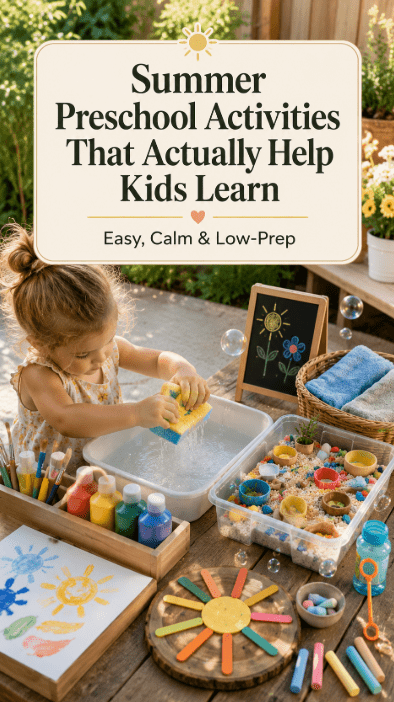
Why Summer Preschool Activities Matter
Preschoolers learn through their whole bodies.
When they scoop water, they are not just playing. They are practicing hand-eye coordination, cause and effect, problem-solving, and early science thinking. When they paint with ice cubes, they are exploring temperature, color mixing, sensory input, and creativity. When they take turns with a watering can or build a sandcastle together, they are practicing patience, communication, and social-emotional skills.
Summer is also a wonderful time to give children more sensory-rich experiences.
Water, sand, grass, flowers, mud, bubbles, chalk, shells, stones, and sunshine all give young children opportunities to notice the world around them. These experiences help build body awareness, attention, language, and emotional regulation.
For many preschoolers, sensory play can be especially calming. Repetitive actions like pouring, scooping, squeezing, brushing, sorting, and washing can help children organize their nervous system after a busy morning or a hot, overstimulating day.
The most helpful activities usually include three things:
A clear beginning
A simple action the child can repeat
A calm ending or transition
This is what turns ordinary summer play into something more supportive.
Instead of rushing from one activity to the next, try thinking of summer preschool activities as tiny learning rituals. A water table can become a calming station. A nature walk can become a language lesson. A craft can become a way to practice patience and self-expression.
Easy Water-Based Summer Preschool Activities
Water play is one of the easiest summer activities for preschoolers because it naturally keeps children engaged. It also works beautifully for hot days when children need movement but may become tired or irritable quickly.
Water activities do not need to be complicated. A shallow bin, a few cups, spoons, sponges, toy animals, or plastic containers can become a full morning of exploration.
1. Sponge Squeeze Transfer
Fill one container with water and leave another container empty. Give your preschooler a large sponge and invite them to soak it, carry it, and squeeze the water into the empty container.
This activity looks simple, but it is excellent for strengthening little hands. The squeezing motion supports fine motor development, which later helps with drawing, cutting, buttoning, and early writing skills.
It also has a calming rhythm. Soak, carry, squeeze. Soak, carry, squeeze.
For children who feel restless or overstimulated, repetitive water play can provide gentle regulation without needing too many instructions.
To make it more playful, add a story: “Can you help fill the pond for the frogs?” or “Can we rescue the garden by bringing water to the flowers?”
2. Toy Washing Station
Set up a washing station with toy animals, cars, dolls, blocks, or plastic play food. Add a bowl of soapy water, a rinse bowl, a towel, and a small brush.
Preschoolers often love real-life imitation play. Washing toys gives them a sense of responsibility and independence while also supporting sequencing skills.
First we wash. Then we rinse. Then we dry.
That simple sequence supports early executive functioning because children are learning to follow steps in order. It can also be a lovely calm-down activity after more active outdoor play.
This activity works especially well in a preschool classroom, therapy room summer setup, or home backyard. If you work with children professionally, you can adapt it into a cooperation activity by assigning roles: washer, rinser, dryer, organizer.
3. Sink or Float Summer Science Bin
Fill a clear bin or large bowl with water. Gather safe summer-themed objects such as leaves, small sticks, shells, stones, corks, toy boats, flower petals, plastic animals, and spoons.
Before placing each object in the water, ask: “Do you think it will sink or float?”
This introduces early scientific thinking in a very natural way. Children learn to predict, observe, compare, and adjust their ideas.
The emotional value is also important. Preschoolers are learning that being wrong is not bad. A prediction is just a guess we test. This can gently build flexible thinking and frustration tolerance.
For a richer language activity, describe what happens:
“The stone sank quickly.”
“The leaf floated on top.”
“The shell went down slowly.”
“The boat stayed above the water.”
This helps build vocabulary while keeping the activity playful.
Sensory Summer Preschool Activities for Calm and Regulation
Summer sensory activities can be joyful and grounding at the same time.
Preschoolers often experience the world intensely. Heat, noise, bright light, long outings, and schedule changes can build up in their bodies. Sensory play gives children a way to return to themselves through touch, movement, repetition, and exploration.
The key is to keep the setup simple and watch how the child responds. Some children become calmer with water and scooping. Others need heavy work, like carrying buckets or pushing a wagon. Some love messy textures, while others prefer dry sensory bins.
There is no one perfect sensory activity. The best one is the activity that helps a child feel more settled, curious, and connected.
4. Ocean Sensory Bin
Create a simple ocean-themed sensory bin using water, blue food coloring if desired, shells, smooth stones, toy sea animals, scoops, and small cups.
Invite children to scoop, pour, sort, and create little ocean stories.
This activity supports pretend play and language development. A child might say, “The turtle is hiding,” “The fish is swimming,” or “The whale needs a cave.” These small stories build imagination and emotional expression.
You can also turn the bin into a calming activity by slowing the pace:
“Let’s move the water gently.”
“Can you make tiny waves?”
“Can the fish swim slowly?”
For children who need help calming their bodies, this kind of guided sensory play can be very soothing.
5. Frozen Pom-Pom Rescue
Place pom-poms or small plastic toys in an ice cube tray or muffin tin, cover with water, and freeze. Then let children “rescue” them using warm water, droppers, spoons, or child-safe tools.
This activity is a favorite because it combines sensory play, science, patience, and problem-solving.
Children learn that ice melts slowly. They have to wait, try different strategies, and notice changes. This can be surprisingly helpful for emotional development because it teaches that some things take time.
For preschoolers who struggle with frustration, you can offer small coaching phrases:
“You are working carefully.”
“The ice is changing.”
“Let’s try one more drop.”
“Waiting is hard, and you are doing it.”
This turns the activity into a gentle practice in persistence.
6. Lemon Water Pouring Station
Add lemon slices, herbs, flower petals, or cucumber slices to a water bin. Give children cups, ladles, funnels, and pitchers.
This sensory station smells fresh and summery without being overwhelming. The pouring motion supports coordination and focus, while the natural scents invite children to notice with more than one sense.
Ask simple observation questions:
“What do you smell?”
“What floats?”
“What color is the water now?”
“What happens when you pour fast or slow?”
For a calming variation, use this as a quiet outdoor station after lunch or before rest time.
Fine Motor Summer Preschool Activities
Fine motor skills are built through small, repeated hand movements.
Preschoolers need these skills for drawing, cutting, dressing, feeding themselves, building, and eventually writing. Summer gives you so many natural ways to strengthen little hands without worksheets or pressure.
The best fine motor activities feel like play. Children should feel like they are creating, helping, building, decorating, or experimenting.
7. Popsicle Stick Pattern Cards
Use colored craft sticks to create simple patterns. Start with two colors, such as red-blue-red-blue. Then invite children to copy or continue the pattern.
You can make this easier by using large pattern cards or harder by adding three colors.
Pattern activities support early math thinking. Children learn to notice order, repetition, and visual differences. They also practice attention and impulse control because they need to pause and look before placing the next stick.
If a child makes a mistake, keep the tone curious:
“Let’s look at the pattern together.”
“What comes next?”
“Should we try again?”
This helps children develop problem-solving without shame.
8. Clothespin Sunshine Craft
Cut out a yellow paper circle and invite children to clip clothespins around the edge to create sun rays.
This is a simple summer craft, but the pinching motion is excellent for strengthening fingers. It also supports bilateral coordination because children often use one hand to hold the circle and the other to clip.
To make it more emotionally meaningful, write or draw small “sunny thoughts” on the rays.
Examples:
I can try again.
I am kind.
I can ask for help.
I can take deep breaths.
I am learning.
This turns a fine motor craft into a gentle confidence-building activity.
9. Shell Sorting Tray
Gather shells, stones, buttons, pom-poms, or summer-themed mini objects. Give children a muffin tin, egg carton, or divided tray and invite them to sort by size, color, shape, or texture.
Sorting supports early math, visual discrimination, and language.
It also gives children a sense of order. For some preschoolers, sorting can be deeply calming because it creates structure from a mixed collection of objects.
Use rich language as you play:
“This shell is smooth.”
“This one has lines.”
“These two are tiny.”
“This stone feels heavy.”
This activity is especially useful for quieter moments, transitions, or small group work.
Outdoor Summer Preschool Activities for Movement and Confidence
Preschoolers need movement to learn.
Running, jumping, crawling, balancing, stretching, pulling, pushing, and climbing all support gross motor development. But movement also affects emotional regulation. Many children become calmer and more focused after they have had a chance to use their bodies.
Summer is a perfect season for outdoor movement activities because you can use simple spaces: a backyard, playground, schoolyard, park, patio, or even a sidewalk.
10. Sidewalk Chalk Obstacle Path
Use sidewalk chalk to draw a movement path.
Include simple prompts:
Jump here
Spin around
Walk on the line
Touch your toes
Hop like a frog
Stretch to the sun
Take three slow breaths
This activity supports motor planning, balance, body awareness, and listening skills.
The breathing prompt is a lovely Eveyou-style addition because it helps children connect movement with calming. Instead of asking children to suddenly “calm down,” you build regulation into the play.
You can also make a social-emotional version:
Draw a heart and ask children to name someone they love.
Draw a cloud and ask them to name a feeling.
Draw a star and ask them to say something they are proud of.
This keeps emotional learning active and playful.
11. Bubble Chase and Breathe
Blow bubbles and invite children to chase, pop, count, or gently catch them.
Then slow the activity down by asking children to blow imaginary bubbles with deep breaths.
This is a beautiful way to introduce breathwork without making it feel clinical. Preschoolers often respond better to images than instructions. “Blow the bubble slowly” is much easier to understand than “regulate your breathing.”
You can teach:
Smell the flower.
Blow the bubble.
Or:
Breathe in slowly.
Blow out gently.
This can become a quick calm-down tool for hot days, transitions, or group time.
12. Garden Scavenger Hunt
Create a simple scavenger hunt with things children can find outside.
Look for:
something green
something soft
something round
something that smells nice
something tiny
something that moves
something that feels rough
This encourages observation, language, attention, and curiosity. It can also help children slow down and become more present.
For children who rush through activities, a scavenger hunt encourages noticing details. For children who feel anxious or overwhelmed, it gently directs attention outward to the environment.
You can do this in a garden, schoolyard, park, or even during a short walk.
Creative Summer Art Activities for Preschoolers
Art gives preschoolers a way to express what they may not yet have words for.
During summer, art can move outdoors, become messier, and involve natural materials. This often makes it feel more freeing for both adults and children.
The goal is not to create a perfect craft. The goal is exploration, expression, and process.
13. Ice Cube Painting
Freeze washable paint mixed with a little water in an ice cube tray. Add craft sticks as handles if you like. Once frozen, let children paint on thick paper outdoors.
This activity is rich in sensory and creative value. Children notice the cold, the melting, the color mixing, and the changing texture.
It also teaches flexibility because the paint does not behave exactly like regular paint. It melts, spreads, drips, and changes. Children learn to adapt.
For children who struggle with perfectionism, process art like this can be especially helpful because there is no “right” result.
14. Nature Collage
Invite children to collect leaves, flower petals, small sticks, grass, and other safe natural materials. Then let them arrange the pieces on paper with glue or contact paper.
Nature collage supports creativity, fine motor skills, and attention to detail.
It also encourages children to see beauty in ordinary things. A small leaf, a tiny petal, or a curved stick becomes part of their artwork.
To add emotional language, ask:
“What does your collage feel like?”
“Does it look calm, happy, wild, sunny, or quiet?”
“What part do you like most?”
These simple questions support emotional awareness without turning the activity into a lesson.
15. Sponge-Stamp Watermelon Art
Cut sponges into simple shapes or use round sponge pieces. Provide red, green, and black washable paint so children can create watermelon-inspired prints.
Stamping is wonderful for preschoolers because it gives quick success. Children who may not yet feel confident drawing can still create something bright and satisfying.
It also supports hand strength, rhythm, and planning.
You can extend the activity by counting seeds, comparing sizes, or talking about favorite summer foods.
Suggested ad placement: after creative art section
Simple Summer Science Activities for Preschoolers
Science for preschoolers should feel like wonder.
They do not need complicated experiments. They need chances to ask, test, notice, and talk about what happened.
Summer offers many natural science themes: water, sun, shadows, ice, plants, bubbles, insects, and weather.
16. Shadow Tracing
On a sunny day, place toys, blocks, or natural objects on paper and trace their shadows. Return later and notice how the shadows changed.
This activity introduces the idea that the sun moves across the sky and shadows shift over time.
For preschoolers, this can feel almost magical. They begin to understand that the world changes, and they can observe those changes.
It also invites patience. You trace once, wait, and come back.
17. Color Mixing with Water
Set out cups of colored water using food coloring or washable liquid watercolor. Give children droppers, spoons, or small pitchers and let them mix colors.
This supports prediction, experimentation, and fine motor skills.
Ask:
“What do you think will happen if we mix blue and yellow?”
“What color did you make?”
“Can you make it lighter?”
“Can you make it darker?”
This activity can become messy, so do it outside or on a tray.
18. Seed Growing Jar
Place a damp paper towel inside a clear jar or plastic bag. Add a bean seed and tape the bag to a sunny window or place the jar somewhere visible.
Children can observe the seed over several days.
This activity is slower than many preschool activities, which is exactly why it is valuable. It teaches waiting, care, and observation.
You can create a simple daily check-in:
What changed?
What stayed the same?
What does the seed need?
This can also become a beautiful metaphor for emotional growth: small things grow with care, time, and patience.
Calming Summer Activities for Overstimulated Preschoolers
Summer can be exciting, but it can also be a lot for a preschool nervous system.
Bright sun, loud outdoor play, travel, late nights, visitors, camps, and less predictable routines can make children more emotional than usual. A child who seems “difficult” may actually be tired, hot, hungry, overwhelmed, or in need of connection.
Calming activities should not feel like punishment. They should feel like a soft landing.
19. Quiet Water Painting
Give children a cup of water and a paintbrush. Let them “paint” the sidewalk, fence, rocks, or patio with water.
This activity is almost magical because the marks appear and then slowly disappear.
It is also very calming. There is no mess, no pressure, and no finished product to evaluate.
Use this after a busy outing, before lunch, or when a child needs a peaceful transition.
20. Summer Calm-Down Basket
Create a simple basket with summer-friendly calming tools.
You might include:
a small fan
a soft cloth
a sensory bottle
a smooth stone
a board book
a feelings card
a stuffed animal
a small pinwheel
a quiet fidget
sunglasses or a hat
The basket can be used at home, in a preschool classroom, in a daycare setting, or in a child therapy room.
The purpose is not to distract children from feelings. It is to help them feel safe enough to settle.
If you want to connect this idea to a child-centered environment, you can also read:
https://eveyou.eu/sensory-room-design-for-counselors-how-to-create-calming-spaces-that-support-regulation-and-healing
21. Cooling Breathing Game
Invite the child to pretend they are cooling down hot soup, warm cocoa, or a sunny beach stone.
They breathe in through the nose and blow out slowly.
This gives children an image they can understand. It also makes breathing playful rather than forced.
Try saying:
“Let’s cool it gently.”
“Slow breath in.”
“Soft breath out.”
“Your body is learning how to slow down.”
This is especially helpful after active play, sibling conflict, or a hot outdoor activity.
How to Create a Simple Weekly Summer Activity Rhythm
One of the best ways to make summer preschool activities easier is to create a gentle weekly rhythm.
This does not mean planning every minute. It simply means each day has a loose theme so you are not constantly wondering what to do next.
Here is a simple example:
Monday: Water play
Tuesday: Art activity
Wednesday: Nature walk or scavenger hunt
Thursday: Sensory bin
Friday: Science experiment
This kind of rhythm supports adults and children.
Adults feel less pressure to invent something new every day. Children feel more secure because the week has a predictable flow.
You can also create a daily rhythm:
Morning: outdoor movement
Midday: water or sensory play
Afternoon: quiet art, books, or calm activity
For preschoolers, predictability is regulating. When children know what comes next, transitions often become easier.
If you are using these activities in a preschool, daycare, homeschool, or therapy-informed setting, consider keeping a simple visual schedule. Use drawings or printed cards so children can see the plan.
For more child-focused space and activity inspiration, you may also like:
https://eveyou.eu/child-therapy-room-decor-ideas-that-foster-safety-creativity-and-emotional-growth
Helpful Supplies for Easy Summer Preschool Activities
This post may contain affiliate links, including Amazon and selected partner links. If you make a purchase through these links, I may earn a small commission at no extra cost to you.
You do not need many supplies to create meaningful summer preschool activities. In fact, too many materials can make activities feel overwhelming.
A small, flexible collection is usually enough.
Useful supplies may include:
washable paint
large paintbrushes
sidewalk chalk
craft sticks
pom-poms
clothespins
child-safe scissors
plastic bins or trays
small scoops and cups
droppers or pipettes
sensory bin tools
bubble wands
storage baskets
laminating sheets for reusable activity cards
Choose supplies that can be used in many ways. A plastic bin can become a water table, sensory tray, toy washing station, science experiment, or sorting activity. Craft sticks can be used for patterns, building, art, counting, and pretend play.
The best supplies are not the fanciest ones. They are the ones children can touch, move, explore, and use again and again.
Safety Tips for Summer Preschool Activities
Summer play should feel relaxed, but preschoolers still need thoughtful supervision.
Always supervise water play closely, even when the water is shallow. Empty bins, buckets, and containers immediately after use. Use taste-safe materials for younger preschoolers who still put things in their mouths.
Be mindful of heat. Preschoolers may not notice they are getting overheated until they are already uncomfortable. Offer shade, water breaks, hats, sunscreen, and calmer activities during the hottest parts of the day.
For sensory play, watch for individual preferences. Some children love messy textures, while others feel distressed by them. Never force a child to touch something that feels uncomfortable. Offer tools like spoons, scoops, brushes, or gloves.
For outdoor nature activities, check for choking hazards, sharp objects, insects, and plants that should not be touched.
The best summer activities feel free, but they are held inside safe, caring boundaries.
Summer Preschool Activities FAQ
What are the best summer preschool activities for hot days?
The best hot-day activities are usually water play, sponge squeezing, toy washing, ice painting, quiet water painting, and shaded sensory bins. These activities help children stay engaged while also cooling their bodies.
Try to avoid highly active games during the hottest part of the day. Save running, obstacle courses, and playground time for morning or later afternoon.
How do I keep preschoolers busy during summer without too much screen time?
Create a simple activity rhythm instead of trying to entertain children all day. Rotate between outdoor movement, water play, sensory bins, art, books, and quiet time.
Preschoolers often repeat the same activity many times when it feels good to their bodies. You do not need a brand-new activity every day. A water bin with different tools can feel new with only small changes.
What summer activities help preschoolers calm down?
Water painting, sensory bins, sponge squeezing, nature walks, breathing games, sorting trays, and quiet art can all support calming.
The most regulating activities usually include repetition, gentle sensory input, and low pressure. Avoid activities with too many rules when a child is already overstimulated.
Are summer preschool activities good for learning?
Yes. Preschoolers learn through play, movement, sensory exploration, imitation, and hands-on experiences.
Water play can support science and motor skills. Sorting supports math thinking. Nature walks support language. Art supports self-expression. Group games support turn-taking and social-emotional development.
What supplies do I really need for summer preschool activities?
Start with basics: washable paint, chalk, a few plastic bins, cups, spoons, craft sticks, pom-poms, child-safe scissors, and simple sensory tools.
You can add more later, but simple open-ended materials are usually more valuable than one-time craft kits.
How long should a preschool summer activity last?
Many preschool activities last 10 to 30 minutes, depending on the child, the setup, and the time of day.
Some children may play with water or sensory bins much longer. Others may move quickly from one activity to another. Instead of forcing a set time, watch the child’s engagement and energy.
How can I adapt these activities for toddlers or older kids?
For toddlers, simplify the materials, avoid small choking hazards, and focus on sensory exploration. Use larger tools and shorter activities.
For older children, add challenges, planning, recording sheets, building tasks, predictions, or cooperative goals. A simple water activity can become a science experiment, design challenge, or group project.
Suggested ad placement: after FAQ
Final Thoughts: Let Summer Play Be Simple and Meaningful
Summer preschool activities do not need to be complicated to be valuable.
A bowl of water, a paintbrush, a sponge, a handful of shells, or a few pieces of chalk can become a rich learning experience when a child has time to explore.
The real beauty of summer play is that it allows children to use their senses, move their bodies, express their ideas, practice patience, and feel connected to the world around them.
As adults, we do not have to create perfect activities.
We can offer simple invitations.
Come pour.
Come paint.
Come notice.
Come build.
Come breathe.
Come try again.
That is where the learning happens.
For more summer activity inspiration, you may also enjoy:
https://eveyou.eu/summer-camp-activities-for-kids-fun-engaging-unforgettable-ideas-for-outdoor-adventures

About the Author
Hi, I’m Eve, a former school counselor with a master’s degree in School Psychology and a passionate advocate for children and families navigating sensory challenges. As a mom of children with sensory sensitivities, I deeply understand the journey special-needs parents face, and I dedicate myself to researching and sharing practical solutions to help children thrive and feel comfortable in their bodies. My goal is also to empower counselors, therapists, and psychologists with creative strategies and supportive resources to enrich their everyday practice. When I’m not writing or exploring new therapeutic approaches, you’ll find me spending quality time with my family and continually seeking inspiration from everyday moments.